
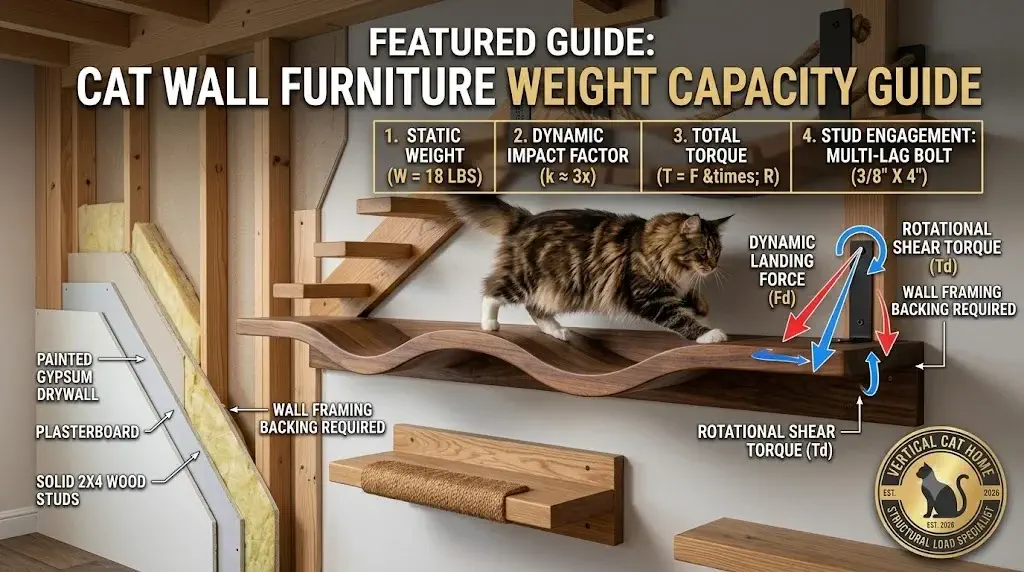
Cat Wall Furniture Weight Capacity Guide: Ratings, Dynamic Loading, and Safe Installation
Cat wall furniture weight capacities range from 30 pounds on lightweight shelves to over 85 pounds on modular stud-anchored systems. A published weight rating represents an isolated benchmark that relies entirely on structural bracket integrity, fastener shear strength, and wall framing backing. For active climbers, large breeds, or multi-cat homes, evaluating safe holding capacity requires analyzing the entire mechanical load path from feline paws to building framing studs.
| Capacity Range | Typical Component Type | Structural Anchoring Requirement | Dynamic Impact Tolerance | Recommended Household Fit |
|---|---|---|---|---|
| Under 30 lbs | Small transit steps, lightweight sisal perches | Heavy-duty hollow-wall drywall anchors | Low (prone to leverage pull-out) | Single small adult cat (under 10 lbs) |
| 30–49 lbs | Standard wood shelves, compact beds, cat bridges | Single stud anchoring + toggle bolt assist | Moderate (absorbs controlled bounds) | Average adult cats (10–14 lbs) |
| 50–64 lbs | Large solid timber planks, curved wave beds | Dual 16″ on-center wood stud lag screws | High (zero platform deflection) | Large breeds (Maine Coon, Ragdoll) |
| 65–85 lbs | Reinforced modular canvas circuits, solid runways | Direct multi-stud structural lag screws | Very High (handles downward leaps) | Multi-cat households & high sprints |
| 85+ lbs | Commercial steel-bracket suites, custom framing | Direct 2×4 framing lag bolts or masonry sleeves | Maximum structural security | Heavy multi-cat colonies (3+ cats) |
Quick Answer: How Much Weight Can Cat Wall Furniture Hold?
Cat wall furniture holds between 30 and 85+ pounds depending on individual component engineering, bracket lever arms, and direct wood stud engagement. Entry-level platforms support up to 30 pounds on drywall anchors, mid-range perches hold 40 to 50 pounds, and multi-stud modular systems withstand up to 85 pounds of dynamic force. Because dynamic jumping forces multiply static body weight, safe holding capacity requires matching hardware to wall construction rather than relying solely on the retail box rating.
- Lightweight furniture (under 30 lbs): Intended for small felines; vulnerable to dynamic pull-out when mounted without studs.
- Standard furniture (30–49 lbs): Adequate for single adult domestic cats when anchored with heavy-duty toggle bolts or into studs.
- Heavy-duty individual perches (50–64 lbs): Built with thick solid timber; requires 16-inch on-center wood stud engagement.
- Modular systems (65–85+ lbs): Disperses dynamic landing shock across multiple studs; ideal for multi-cat households and big breeds.
For an evaluation of heavy-gauge brackets and tested solid wood platforms, review our dedicated guide to the best heavy-duty cat wall shelves.
What Does Cat Wall Furniture Weight Capacity Mean?
Weight capacity defines the maximum mechanical load a specific cat wall component supports under controlled laboratory mounting conditions. That factory rating does not guarantee that every residential installation will safely hold the identical weight. Evaluating real-world stability requires separating three distinct physical concepts:
Published Weight Capacity
The isolated static limit claimed by the manufacturer under ideal mounting conditions.
Installed Capacity
The practical holding limit achieved when anchored into specific residential walls (studs vs. hollow drywall).
Real-World Dynamic Loading
The kinetic downward and rotational shear forces generated as a cat leaps, lands, turns, and accelerates.
A 50-pound rated shelf attached to hollow 1/2-inch gypsum drywall with plastic expansion plugs will fail at a fraction of its advertised capacity when subjected to dynamic leaping impacts.
How Much Weight Can Cat Wall Furniture Hold?
Manufacturer specifications demonstrate that cat wall furniture holding limits vary widely from 30 to over 85 pounds across different component formats. Engineering limits differ based on whether the component is a narrow stepping block, an expansive resting bed, or a multi-stud hammock:
| Published Capacity Range | Typical Structural Interpretation | Critical Installation Check |
|---|---|---|
| Under 30 lb | Light-duty component | Verify anchor type and cat weight; avoid high-jump descents |
| 30–49 lb | Moderate-capacity platform | Ensure solid fastener bite into timber framing or heavy toggle anchors |
| 50–64 lb | Heavy-duty individual shelf | Mandatory 16″ on-center wood stud alignment |
| 65–85 lb | Heavy-duty modular component | Confirm multi-stud bracket spans and thick screw gauge |
| 85+ lb | Reinforced architectural system | Verify manufacturer structural documentation and wall substrate limits |
For example, Catastrophic Creations documents weight-tested capacities of up to 85 pounds for specific solid wood shelves and 65 pounds for heavy duck canvas hammocks when mounted directly into wall studs. In contrast, standard kits often rate complete assemblies between 35 and 45 pounds, requiring careful hardware auditing before installation.
Published Capacity vs. Installed Capacity
Installed holding capacity drops significantly whenever mounting hardware deviates from factory-tested stud engagement. A manufacturer tests a shelf using thick wood screws driven into solid wood framing under steady vertical pressure. When homeowners alter that configuration, structural holding power changes instantly:
- The wall framing must match the manufacturer’s specified fastener pattern.
- Fasteners must reach full penetration depth (minimum 2 inches into solid wood studs).
- All factory-drilled bracket holes must be secured; skipping screws reduces shear resistance by 50% or more.
- The published rating applies strictly to that specific shelf, not to adjacent components in the same set.
Never treat a published weight rating as a universal guarantee. Changing the fastener type, stud spacing, or wall substrate directly alters the safe capacity.
Static Weight vs. Dynamic Loading
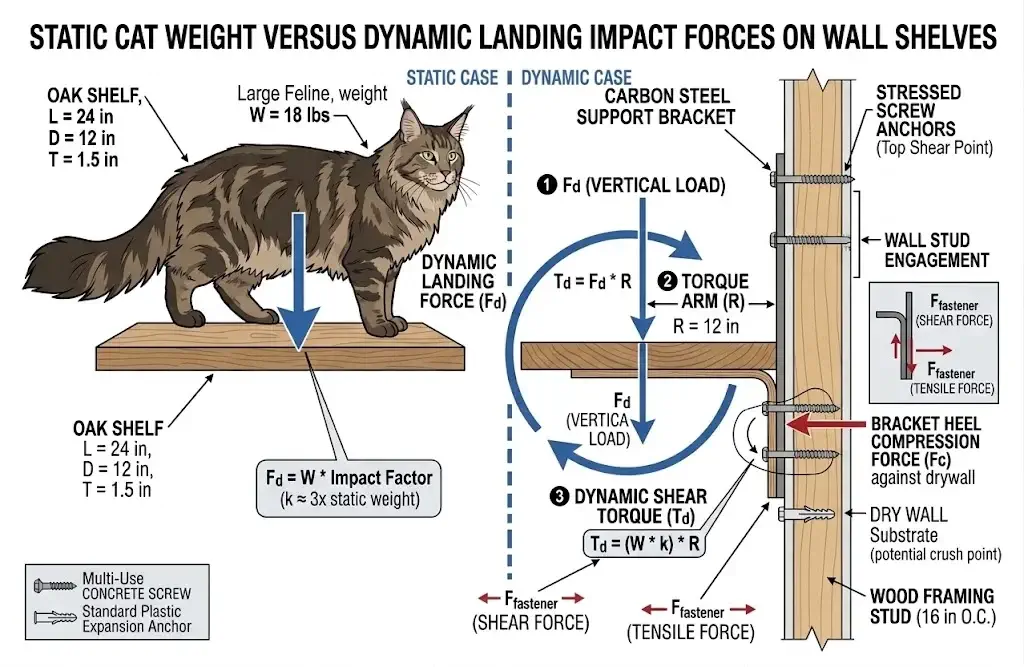
Dynamic feline landings multiply static body weight up to three times through downward kinetic energy and rotational torque. When a 15-pound cat leaps onto a wall perch, downward velocity, stopping distance, and shelf depth combine into a rotational force that levers top screws outward away from the wall:
Clinical feline behavior guidelines from the American Association of Feline Practitioners (AAFP) on feline environmental needs confirm that surface instability causes feline hesitation and behavioral rejection. Shelves that flex or creak during landing erode cat confidence, causing pets to abandon vertical spaces entirely.
What Determines Cat Wall Furniture Weight Capacity?
Total weight capacity represents the sum of every mechanical link in the structural load chain. Seven interrelated factors dictate whether a wall-mounted installation remains rigid over years of daily use:
- Platform Structure: Timber thickness (15mm+), grain orientation, and multi-ply construction prevent plank bowing.
- Mounting Bracket Architecture: Heavy-gauge carbon steel brackets with gusseted corner braces resist rotational bending.
- Fastener Attachment Density: Spreading load across multiple vertically aligned screws reduces stress on individual fasteners.
- Wall Substrate Composition: Solid timber studs or masonry provide secure anchoring, while hollow drywall alone offers minimal shear resistance.
- Fastener Quality: Sized #10 or #12 structural wood screws resist shear forces that strip weak commercial zinc screws.
- Usable Platform Depth: Deeper shelves increase the cantilever lever arm, requiring stronger upper bracket anchoring.
- Installation Precision: Confirming stud centers, drilling proper pilot holes, and driving screws flush ensures factory-tested strength.
For a complete analysis of cantilever physics and fastener selection, read our in-depth heavy-duty cat wall furniture buying guide.
Why Mounting Matters More Than the Number on the Box
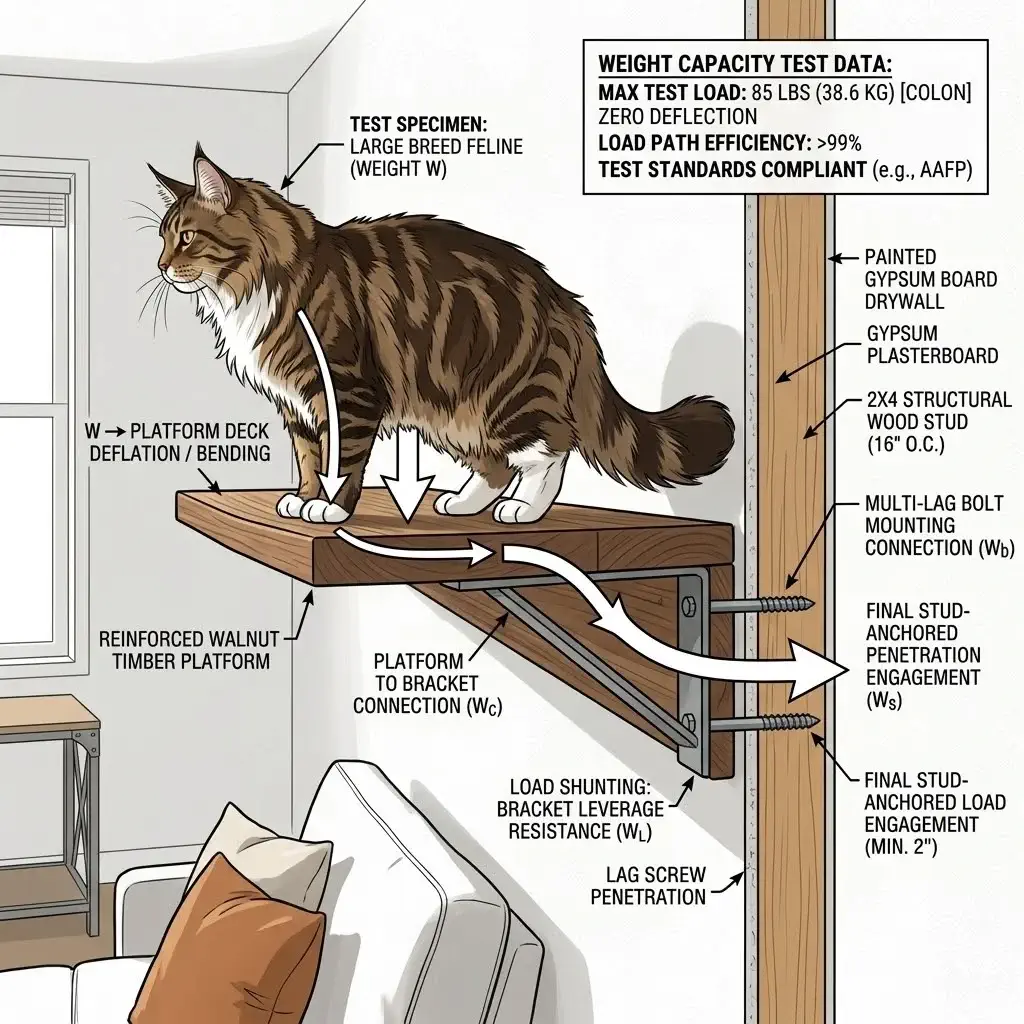
Wall mounting serves as the foundational structural link that transfers feline kinetic energy safely into the building framework. The path of dynamic force follows a strict sequential chain:
If any single connection fails, the entire shelf collapses. This is why manufacturers design high-capacity systems around 16-inch or 24-inch stud spacing. For step-by-step stud locating and drilling instructions, follow our guide on how to mount cat shelves into studs.
Cat Wall Furniture Weight Capacity by Wall Type
Different wall construction materials determine the mechanical anchors and maximum safe loads achievable in residential installations. Hardware that performs exceptionally well in solid brick will fail completely in hollow gypsum drywall:
| Wall Substrate | Primary Structural Factor | Required Hardware & Verification |
|---|---|---|
| Wood Stud Wall (Drywall Over Framing) | Maximum shear strength | 2.5″–3.0″ #10 structural wood screws centered in 2×4 studs |
| Metal Stud Wall (Commercial/Condo) | High holding capacity | 1/4″ heavy-duty steel channel snap-toggles; wood screws will strip |
| Hollow Drywall Only (No Studs) | High failure risk under dynamic shock | Heavy steel toggle bolts only; avoid for cats over 12 lbs |
| Poured Concrete & Solid Masonry | Exceptional holding stability | Masonry hammer drill bits, expanding steel sleeve anchors, or Tapcons |
| Lath and Plaster (Historic Homes) | Brittle substrate; prone to cracking | Must find underlying wood lath framing studs; pre-drill to avoid cracking |
Why Component Ratings Matter
Individual component ratings vary within modular cat wall collections based on platform size and structural bracket design. A multi-piece kit advertising an “80-pound capacity” often applies that rating solely to its primary multi-stud resting bed, while adjacent stepping rungs may only hold 20 pounds before bending.
- Lounging Perches: Engineered for sustained static loads (50+ lbs) across multiple studs.
- Stepping Blocks: Subjected to sudden dynamic take-off forces (35–45 lbs).
- Fabric Hammocks: Utilize flexible canvas to absorb dynamic landing impact, reducing wall stress.
- Rope Bridges: Disperse weight across twin anchors, but require secure end plates to prevent sagging.
Weight Capacity for Large Cats
Large-breed cats require broader platform footprints and reinforced brackets to prevent tipping under shifted body weight. A heavy Maine Coon or Ragdoll weighing 18 to 25 pounds needs more than just a strong shelf; it requires sufficient usable surface area so its body doesn’t hang over the edge during sleep:
- Verified Holding Capacity: Target individual component ratings of 45 to 50+ pounds.
- Usable Platform Depth: Ensure shelves measure at least 10.5 to 12 inches deep to accommodate broad torsos.
- Stud Anchoring: Fasten directly into wood wall studs to eliminate platform flex.
- Landing Clearance: Provide generous approach paths so heavy cats can land without colliding with nearby walls.
For verified furniture models built specifically for large-frame felines, browse our curated roundup of the best cat wall furniture for large cats.
Weight Capacity for Multiple Cats
Multi-cat households require calculating combined feline body mass on shared perches and designing dual ascent circuits. Two 12-pound cats wrestling or sleeping on a single platform create a 24-pound static load that spikes above 50 pounds during high-speed chases. Systems must provide multiple wide destinations to prevent territorial bottlenecking.
How to Read a Cat Wall Furniture Weight Rating
Systematic spec audits ensure advertised weight ratings match your specific home installation requirements. Review these ten critical verification points before making a purchase:
- Does the rating apply to a single platform or the entire multi-piece kit combined?
- Is the published capacity factory-tested under load or simply an unverified marketing estimate?
- Does the manufacturer require mounting into wood studs to achieve the stated weight limit?
- Do the pre-drilled bracket mounting holes match standard 16-inch residential stud spacing?
- How many total structural screws anchor each individual bracket?
- What grade of mounting hardware is included in the packaging (cheap drywall plugs vs. heavy wood screws)?
- Are usable resting dimensions clearly separated from outer decorative frame borders?
- Does the platform allow large felines to turn around without edge slippage?
- Does the manufacturer list weight restrictions for multi-cat simultaneous use?
- Are replacement traction pads and wear components available for long-term maintenance?
Common Cat Wall Furniture Weight-Capacity Mistakes
Avoiding critical installation and sizing oversights prevents catastrophic wall damage and pet injuries. Protect your walls and cats by avoiding these seven common pitfalls:
- Chasing the Largest Number on the Box: An 80-lb total kit capacity often masks weak 15-lb individual stepping perches.
- Treating Brand Ratings as Universal: Hammocks, solid wood shelves, and rope steps within the same collection have very different weight limits.
- Relying Exclusively on Hollow-Wall Plugs: Plastic drywall anchors eventually pull loose under dynamic feline jumping impacts.
- Confusing Weight Rating with Usable Space: A shelf can be strong enough to hold 50 pounds but too narrow for a cat to turn around comfortably.
- Skipping Factory Installation Hardware: Substituting undersized wood screws reduces fastener shear strength by half.
- Overlooking Wall Composition: Driving wood screws into metal studs or failing to pre-drill lath-and-plaster walls leads to loose mounts.
- Assuming Static Weight Matches Dynamic Movement: Failing to account for the impact force generated when a heavy cat leaps from a height.
How Much Weight Capacity Do You Actually Need?
Target capacity requirements depend on your cat’s adult body mass, jumping activity, and household dynamics. Use this guideline to select the appropriate capacity tier:
| Feline Household Profile | Minimum Target Capacity | Primary Architectural Focus |
|---|---|---|
| Single Average Adult Cat (8–12 lbs) | 30–35 lbs per shelf | Heavy-duty toggle anchors or single stud mounting |
| Single Large Breed Cat (15–25 lbs) | 45–50+ lbs per shelf | Mandatory 16″ wood stud anchoring & 11″+ usable depth |
| Two Cats Sharing Perches | 50–65 lbs combined | Expansive horizontal decks spanning multiple framing studs |
| Multi-Cat Colony (3+ Cats) | 65–85+ lbs modular suite | Dual vertical ascent paths and widely distributed rest areas |
| High-Energy Climbers & Sprinters | 50+ lbs with zero flex | Steel-braced triangular brackets with shock-absorbing surfaces |
How to Check Installed Cat Wall Furniture
Regular hardware inspections catch loosened screws and bracket fatigue before structural wall failures happen. Perform this 5-minute safety check every six months:
- Test for Play: Apply two-handed downward pressure to the outer edge of each shelf; there should be zero wobble or bracket flex.
- Inspect Drywall Seams: Look for hairline cracks or crumbling gypsum dust around screw holes.
- Check Screw Tightness: Use a manual screwdriver to verify that mounting screws remain seated firmly against brackets.
- Verify Level Alignment: Use a spirit level to ensure platforms haven’t begun sagging outward under sustained use.
- Examine Wear Parts: Inspect sisal ropes, canvas seams, and carpet pads for fraying that could compromise traction.
The Bottom Line on Cat Wall Furniture Capacity
True cat wall furniture strength depends on a complete load-bearing system that securely transfers kinetic forces into solid wall framing. Published weight ratings provide a useful baseline, but real-world reliability comes down to four fundamental factors:
Weigh your cats, locate your wall studs, verify the usable platform dimensions, and construct a gradual, low-impact climbing route that will keep your cats active, comfortable, and safe for years to come.
Frequently Asked Questions (FAQ)
How much weight can a cat wall shelf hold?
Published capacities vary from 30 pounds on compact shelves to 50 pounds for heavy-duty individual perches, and up to 85 pounds for multi-stud modular components. Safe holding capacity depends on whether brackets are anchored directly into wood studs or hollow drywall.
Is a 50-pound cat shelf strong enough for a large cat?
Yes, a 50-pound rated shelf provides plenty of structural support for large breeds like Maine Coons (15–25 lbs). However, you must also ensure the shelf provides at least 10.5 to 12 inches of usable front-to-back depth so the cat can rest comfortably without body overhang.
Does cat wall furniture need to be mounted into studs?
For large cats, multiple cats, or active climbing routes, mounting directly into wooden wall studs is essential. While hollow-wall drywall anchors can hold lightweight resting shelves, dynamic jumping impacts will eventually work drywall anchors loose over time.
Can two cats use one cat wall shelf?
Two cats can share a shelf if the platform is anchored across multiple wall studs and has a published rating of at least 50 to 65 pounds. The platform must also be long enough (30+ inches) to allow both cats to lie down without competing for space.
Does jumping affect cat wall furniture weight capacity?
Yes. Dynamic landing forces multiply a cat’s static weight by two to three times due to downward kinetic velocity. This downward impact creates rotational torque that pulls the top bracket screws outward away from the wall.
How often should cat wall furniture be inspected?
Inspect wall-mounted fixtures every six months. Apply downward pressure by hand to verify zero bracket play, check screw tightness with a screwdriver, and inspect drywall around mounting plates for hairline cracking.
