
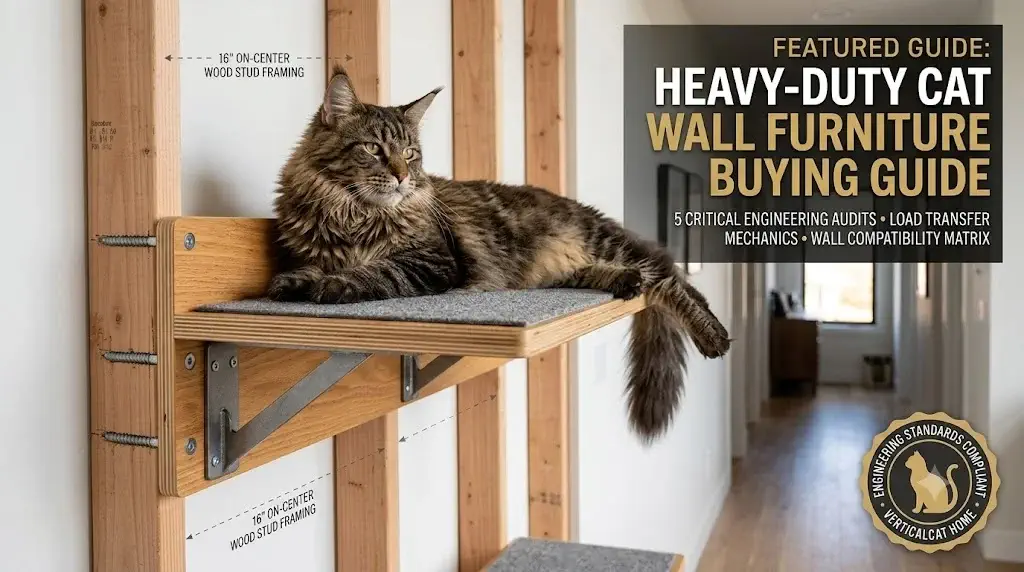
Heavy-Duty Cat Wall Furniture Buying Guide (2026 Engineering Standards)
Heavy-duty cat wall furniture should be evaluated as a complete load-bearing system, not by the advertised weight rating alone. A strong platform can still be a poor choice if its brackets, fasteners, wall connection, usable surface, or installation method are not appropriate for repeated cat movement. For heavier cats, multiple cats, or high-activity climbing routes, the buying decision must systematically audit load transfer physics, structural framing substrate compatibility, usable platform geometry, and dynamic impact deceleration.
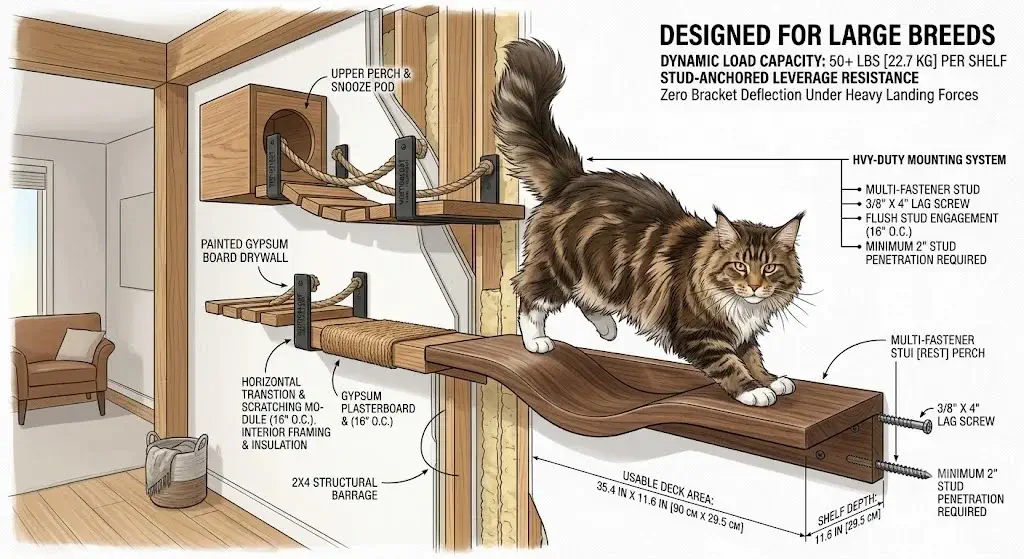
Quick Reference Specification: Heavy-Duty Structural Load Matrix
| Hardware Archetype | Primary Substrate | Anchoring Requirement | Dynamic Shear Rating | Target Large-Cat Utility |
|---|---|---|---|---|
| Bentwood Contoured Perch | Multi-ply Hardwood / Oak | Dual 16″ Center Studs | 50+ lbs dynamic load | Maine Coon & Ragdoll sprawled resting |
| Multi-Stud Horizontal Runway | Solid Timber / Birch Ply | Triple Stud Anchor (32″-48″ Span) | 70+ lbs distributed | Multi-cat passing & high-speed transit |
| Canvas Modular Hammock | Bamboo & Heavy Duck Canvas | 16″ or 24″ Stud Centers | 62 lbs dynamic shear | Shock-absorbing landings from height |
| Steel-Braced Stepping Block | Solid Pine / Carbon Steel | Single Stud + Toggle Bolts | 45 lbs per step | Vertical climb waypoints without flex |
| Enclosed Heavy-Duty Condo | 15mm Cabinet-Grade Plywood | Direct Dual Stud Lag Screws | 80+ lbs static / shear | Private resting for heavy senior cats |
Quick Answer: How to Choose Heavy-Duty Cat Wall Furniture?
Heavy-duty cat wall furniture succeeds only when mechanical fasteners transfer downward kinetic energy directly into solid wood studs rather than relying on hollow drywall anchors. For active large felines weighing 15 to 25+ pounds, a reliable system must combine substantial platform construction, multiple structural mounting brackets, and at least 11 inches of usable resting depth. Never treat a high static weight label as proof of product safety without verifying fastener engineering and wall substrate requirements.
- Best heavy-duty approach: Choose furniture with documented dynamic load ratings, multiple structural attachment points, and direct stud-mounting patterns.
- Best premium single perch: The Refined Feline Lotus Leaf (supports 50 lbs across 16-inch stud spacing).
- Best long heavy-duty platform: The Refined Feline Lotus Branch (spans 60.25 inches across multi-stud connections).
- Best modular heavy-duty approach: Catastrophic Creations Modular Cat Wall System (shock-absorbing canvas and bamboo).
- Best complete heavy-duty setup: Audit the load capacity and mounting mechanics of every individual shelf rather than trusting a single kit-wide rating.
To compare specific tested models built with heavy-gauge steel brackets and thick timber decks, review our curated rankings in the best heavy-duty cat wall shelves guide.
What Does “Heavy-Duty” Mean in Cat Wall Furniture?
Heavy-duty cat wall furniture defines a complete structural assembly capable of absorbing repeated dynamic landing torque while maintaining structural stability against building framing. True heavy-duty classification requires two independent engineering thresholds:
- Furniture Structural Integrity: The platform, cantilever brackets, joint hardware, and raw substrates must withstand vertical deflection under concentrated force.
- Installation Substrate Anchorage: The connection between brackets and wall studs must safely transfer dynamic shear loads without tearing out drywall paper or pulling anchor threads loose.
A thick solid-oak platform fastened with plastic drywall plugs will fail under dynamic impact, just as a flimsy particle-board shelf will crack even when bolted into solid wood framing.
The VerticalCatHome Heavy-Duty Performance Equation:
Heavy-Duty Reliability = Platform Stiffness + Bracket Lever Arm + Fastener Shear Strength + Wall Stud Engagement
This technical assessment model isolates structural failure points across dynamic residential environments.
Heavy-Duty Does Not Mean “Can Hold the Most Weight”
Published static weight limits measure motionless resting mass rather than biological comfort, landing clearance, or rotational bracket torque. A compact shelf tested with a 50-pound iron kettlebell cannot automatically accommodate a living 18-pound cat that needs space to twist, land, and decompress its spine:
| Engineering Specification | Shelf A (Static-Optimized) | Shelf B (Biomechanically Designed) |
|---|---|---|
| Published Static Capacity | 50 lbs | 40 lbs |
| Usable Platform Depth | 7.0 inches (spillover risk) | 12.0 inches (full torso fit) |
| Fastener Attachment Points | Single central bracket point | Dual 16″ on-center stud fasteners |
| Large-Breed Usability | Severely restricted (cramped) | Excellent (turning & sprawling) |
| Dynamic Shear Leverage | High outward pull on top anchor | Dispersed evenly across wood framing |
Although Shelf A lists a higher capacity on paper, Shelf B is the superior heavy-duty choice because it accounts for biological dimensions, bracket lever arms, and realistic dynamic jumping forces.
Static Weight vs. Real-World Cat Loading
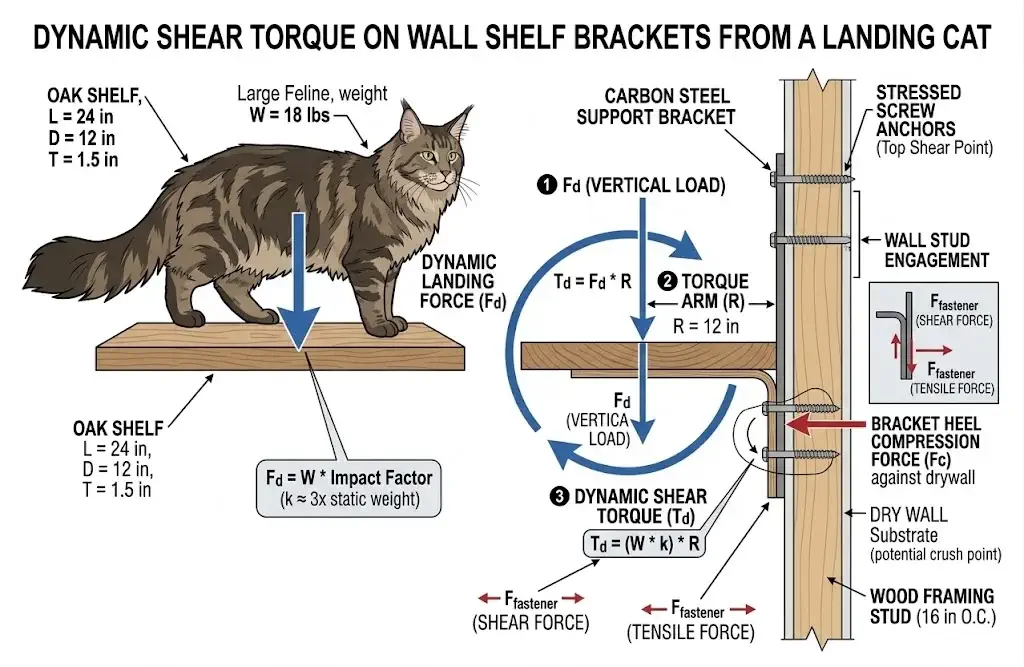
Dynamic feline kinetic energy multiplies static body weight up to three times during aggressive running descents and vertical leaps. When a cat pushes off or lands, it generates multi-vector kinetic forces that stress brackets far beyond a simple deadweight load:
- Still Resting: Minimal gravitational downward force with zero lateral torque.
- Pacing & Turning: Asymmetrical shifts that apply alternating lateral torque on bracket fasteners.
- High-Speed Landing: Sudden downward impact force combined with forward rotational momentum.
- Horizontal Push-Off: Rearward shear force that tries to lever the top mounting screws out of the drywall.
- Edge-Loaded Impact: Landing on the outer perimeter maximizes bracket lever-arm torque.
Authoritative behavioral and clinical guidelines from the American Association of Feline Practitioners (AAFP) on feline environmental needs confirm that unstable surfaces cause hesitation, stress, and behavioral refusal. Prioritize structural framing anchors to ensure zero platform movement under active use.
1. Start With the Cat’s Actual Weight
Accurate digital scale measurements establish the baseline structural threshold required before designing wall routes. Relying on breed generalizations is a common mistake; two adult Maine Coons or Ragdolls can vary by over ten pounds:
- Weigh each cat individually using a calibrated pet scale.
- Calculate the combined weight for multi-cat households where felines share loungers.
- Factor in active jumping angles (high leaps from desks or cat trees produce higher kinetic forces).
- Account for future growth in young large-breed kittens that will add mass through age four.
2. Look for a Published Weight Capacity
Manufacturer-documented weight capacities provide verified structural benchmarks that eliminate marketing ambiguity. Generic product descriptions like “ultra strong” or “heavy duty” offer no engineering value without documented numbers.
Premium manufacturers document verified capacities alongside usable platform footprints. For instance, The Refined Feline documents a 50-pound support limit for its Lotus Leaf (22″ × 10.5″) and Lotus Branch (60.25″ × 10.5″). This gives buyers verified dimensions to evaluate against their cat’s body size and home layout.
3. Check Whether the Capacity Applies to One Component or the Entire System
Multi-piece modular ratings frequently represent collective kit load rather than individual platform strength. Marketplace kits often advertise an impressive “80-lb total capacity” across an 8-piece setup, while the individual stepping rungs may only hold 15 pounds before bending.
Caregivers must audit the individual load limits of every component—bridges, steps, scratching posts, and hammocks—before mounting heavy cats overhead.
4. Evaluate the Wall Before the Furniture
Wall substrate composition dictates load transfer mechanics and fastener requirements across residential homes. Mounting performance depends entirely on the wall material behind the paint:
- Standard Drywall over Wood Studs (16″ on-center): The optimal US residential framing setup; allows heavy screws to bite directly into 2×4 timber studs.
- Lath and Plaster (Older Homes): Prone to crumbling under point loads; requires finding underlying wood studs to prevent wall blowouts.
- Solid Masonry & Poured Concrete: Delivers exceptional shear strength when paired with expanding sleeve or masonry anchors.
- Metal Stud Framing (Commercial/Condo High-Rises): Demands heavy-duty snap toggles; standard wood screws will strip out of thin gauge steel.
5. Do Not Confuse Drywall Anchors With Stud Mounting
Drywall anchors transfer loads into fragile 1/2-inch gypsum plasterboard, whereas stud mounting anchors directly into vertical structural timber framing. Even the best plastic ribbed anchors or zinc self-drilling plugs can pull out under dynamic jumping loads. When mounting heavy-duty platforms, review our technical guide on how to mount cat shelves into studs.
6. Examine the Number and Location of Attachment Points
Spreading bracket attachment holes across a wide footprint distributes rotational shear forces and protects wall surfaces. Cantilever shelves with narrowly clustered mounting screws exert extreme leverage against upper fasteners. Look for brackets with wide vertical spacing between screw holes to better counter outward pulling forces.
7. Platform Depth Matters for Heavy Cats
Adequate usable shelf depth prevents larger cats from hanging over edges and experiencing muscular fatigue during rest. A heavy-duty shelf must measure at least 10.5 to 12 inches deep to accommodate sprawling adult cats. For breed-specific dimensions, check our review of the best cat wall furniture for large cats.
8. Look at Material Construction
Cabinet-grade birch plywood and solid hardwoods provide superior screw-holding strength compared to cheap particle board. Dense multi-ply hardwood cores resist internal delamination when subjected to repeated upward-and-downward lever forces from heavy landings.
9. Inspect Brackets and Structural Hardware
Heavy-gauge stamped carbon steel brackets prevent platform sag under sustained adult feline weight. Weak stamped aluminum or decorative stamped wire can bend over time, causing platforms to tilt outward and startle cats. Look for gusseted corners or welded triangular supports.
10. Separate Furniture Strength From Installation Strength
A platform’s structural capacity remains completely useless if its wall attachment hardware fails under dynamic shear force. True heavy-duty performance requires equal parts material strength and secure wall mounting:
| Engineering Question | Structural Metric Measured |
|---|---|
| How much static weight can the plank hold? | Platform internal tensile & bending strength |
| How is the bracket fastened to the wall? | Fastener tensile & shear load resistance |
| What substrate lies behind the drywall? | Wall framing structural load transfer capability |
| How many framing studs are engaged? | Load distribution footprint across room structure |
| What is the usable depth and landing clearance? | Real-world feline ergonomics and slip safety |
11. Heavy-Duty Single Shelf vs. Heavy-Duty Wall System
Choosing between a single large perch and an integrated climbing route depends on available wall span and room traffic. A single long perch creates an expansive lounging destination without extensive wall penetrations, whereas a complete wall system distributes activity across multiple stepping levels.
12. When a Long Platform Makes More Sense
Continuous horizontal runways allow large cats to pace, pass each other, and rest without encountering dead-end drop-offs. Shelves spanning 48 to 60 inches allow multiple anchor points across three standard 16-inch studs, distributing weight more effectively than isolated brackets.
13. Heavy-Duty for One Large Cat vs. Multiple Cats
Multi-cat households require higher cumulative load capacity and two distinct escape routes to prevent territorial bullying. When two large cats share a vertical highway, platforms must support combined dynamic loads while offering multiple ascent and descent paths.
14. Heavy-Duty Does Not Mean “Make the Cat Jump Higher”
Excessive vertical gaps between shelves subject heavy cats’ carpal joints to high impact forces during descents. Keep step heights between 10 and 14 inches to ensure smooth, low-impact transitions that protect heavy adult cats from long-term joint wear.
15. Think About Landing Areas, Not Just Platforms
Clear physical approach paths prevent awkward landing twists and high-impact slips against door frames or walls. Never position a landing shelf directly beside swinging doors, projecting trim, or tight corners that restrict a large cat’s landing approach.
16. Installation Quality Is Part of the Product Choice
Poor installation technique compromises even the highest-rated structural cat furniture. Always use an electronic stud finder, confirm stud centers, drill proper pilot holes, and drive 2.5-to-3-inch structural wood screws flush to the bracket face.
17. Inspect Heavy-Duty Furniture After Installation
Periodic fastener torque checks catch loosened screws before structural wall failures occur. Inspect heavy-use wall circuits every six months for hairline drywall cracking, platform wobble, or bracket screw pullout.
18. How to Compare Heavy-Duty Cat Wall Furniture
Rigorous evaluation separates authentic heavy-duty engineering from superficial product marketing. Use this comparative benchmark matrix before buying:
| Evaluation Criterion | Verified Engineering Evidence | Unverified Marketing Claims |
|---|---|---|
| Weight capacity | Specific dynamic/static ratings per shelf | Vague “extra strong” labels |
| Construction materials | Solid pine, birch plywood, welded steel | Generic “composite wood” |
| Mounting documentation | Detailed stud-spacing diagrams | “Easy peel-and-stick / universal” |
| Platform dimensions | Exact usable width and depth listed | Exterior overall box dimensions only |
19. A Heavy-Duty Buying Scorecard
Systematic pre-purchase audits ensure cat furniture matches your walls and your cat’s weight. Use this checklist before ordering wall-mounted fixtures:
| Audit Question | Pass Indicator | Warning Sign |
|---|---|---|
| Is capacity documented per component? | Yes, specific numbers provided | Only total kit capacity listed |
| Does it specify 16″ wood stud mounting? | Yes, bracket holes align with studs | Drywall anchors recommended as primary |
| Is usable platform depth over 10.5 inches? | Yes, ample room for adult felines | Under 9 inches deep |
20. When to Reject a Heavy-Duty Cat Wall Product
Rejecting structurally inadequate cat furniture prevents catastrophic wall failures and pet injuries. Discard any product that relies on chemical adhesives for large-cat use, uses flimsy stamped aluminum brackets, hides true platform dimensions, or omits stud installation instructions.
21. Heavy-Duty Wall Furniture for Large Cats
Accommodating large-breed cats requires evaluating chassis stiffness alongside anatomical body dimensions. While structural anchoring provides the needed support, usable depth (11″+) ensures large cats can relax without slipping off during deep sleep.
22. Heavy-Duty Wall Furniture for Multiple Cats
Multi-cat installations require wider shelves and secondary ascent paths to prevent territorial disputes. Even the sturdiest shelf will go unused if dominant cats can easily trap more timid felines on a single dead-end perch.
23. Heavy-Duty vs. Standard Cat Wall Furniture
Heavy-duty wall installations use thicker solid wood platforms and heavy-gauge steel framing brackets compared to standard cat shelves. Standard furniture is designed for average 8-to-10-pound cats; heavy-duty systems use reinforced brackets engineered to handle dynamic landing forces from heavy felines:
| Feature Comparison | Standard Cat Shelves | Heavy-Duty Cat Wall Furniture |
|---|---|---|
| Wood Thickness | 8mm to 12mm particleboard | 15mm to 20mm solid wood / multi-ply |
| Bracket Gauge | Thin stamped sheet metal | Heavy-gauge carbon steel brackets |
| Mounting Method | Basic drywall expansion plugs | Structural stud lag screws or snap toggles |
24. Heavy-Duty Does Not Always Mean Larger
Compact stepping perches can deliver exceptional structural rigidity when anchored directly into wood studs. A small 8×8-inch stepping perch built with a welded steel plate is structurally stronger than a flimsy 30-inch shelf that flexes under a cat’s weight.
25. Maintenance and Replaceable Components Matter
Modular replacement pads and sisal segments extend the working lifespan of wall-mounted cat furniture. Look for systems with removable, washable carpet liners and replaceable scratching inserts so you can maintain the furniture without removing the anchored brackets from the wall.
Heavy-Duty Cat Wall Furniture Buying Checklist
Complete this step-by-step checklist to ensure safe, secure installation before drilling into your walls:
- ☐ Cat’s Actual Weight Measured: Weighed on a calibrated scale (plus combined mass if cats share shelves).
- ☐ Published Capacity Verified: Verified specific component weight ratings rather than vague kit claims.
- ☐ Usable Dimensions Confirmed: Platform measures at least 10.5″ deep by 18″ wide of clear surface.
- ☐ Wall Substrate Identified: Located 16″ wood studs, masonry, or verified hollow-wall cavity depth.
- ☐ Appropriate Fasteners Selected: Sized 2.5″+ wood screws or heavy-duty hollow-wall anchors.
- ☐ Landing Approach Cleared: Verified zero collision hazards near door swings or furniture corners.
- ☐ Post-Mount Deflection Tested: Manually tested with two-handed downward force to confirm zero platform flex.
Final Buying Decision: Sizing the Complete System
Selecting the right heavy-duty cat wall furniture requires balancing feline body fit, bracket engineering, and secure wall anchoring. Never rely on marketing labels alone. The most reliable setup is one where:
Start by weighing your cat, locate your wall studs, verify the true usable platform dimensions, and construct a gradual, low-impact climbing route that will keep your cats active and safe for years to come.
Frequently Asked Questions (FAQ)
What is heavy-duty cat wall furniture?
Heavy-duty cat wall furniture consists of wall-mounted shelves, hammocks, and steps engineered with solid wood or metal reinforcements and heavy-duty brackets designed to safely handle the dynamic landing forces of large cats.
How much weight should heavy-duty cat wall furniture support?
A quality heavy-duty shelf should support a static load of at least 40 to 50 pounds per platform. This provides a safe buffer for dynamic landing forces when a 15-to-25-pound cat leaps onto the shelf.
Should heavy-duty cat shelves be mounted into studs?
Yes, direct stud mounting is essential. Fastening structural brackets directly into wooden wall studs with 2.5-inch or 3-inch screws provides the shear strength needed to prevent shelves from pulling out of the wall.
Can heavy-duty cat furniture be installed on drywall without studs?
If studs are inaccessible, only heavy-duty steel toggle bolts (such as 1/4-inch snap toggles) should be used. Never use standard plastic expansion anchors, as dynamic feline jumping forces will quickly pull them out of drywall.
Is platform depth important for heavy cats?
Yes. Large cats need at least 10.5 to 12 inches of usable front-to-back depth so they can turn around and lie down comfortably without hanging off the edge.
