
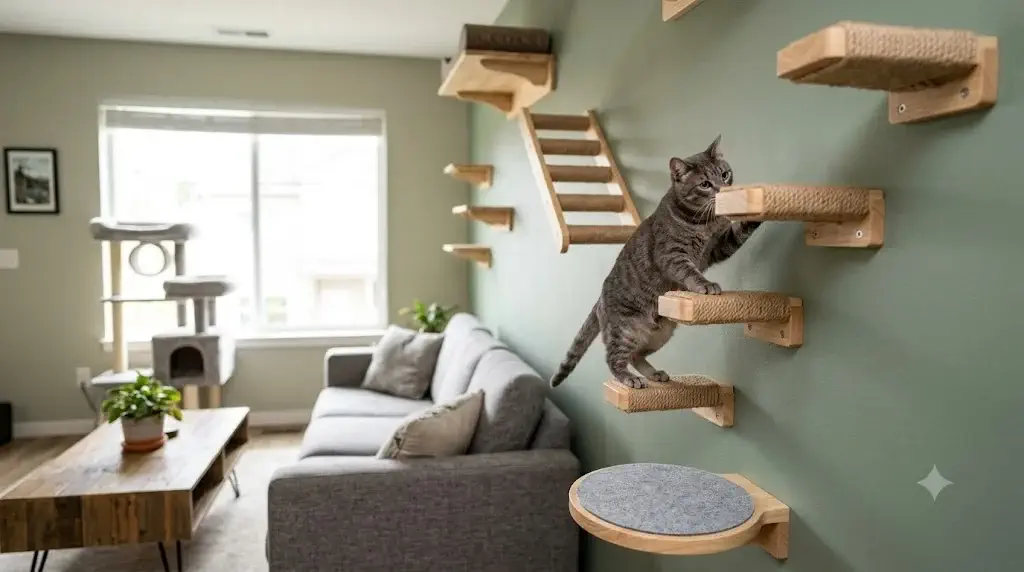
5 Best Cat Wall Steps: Climbing Pegs & Floating Stairs
The best cat wall steps establish safe vertical ascent corridors that prevent high-impact joint trauma during downward descents. While broad lounging shelves serve as resting endpoints, the best cat wall steps function as intermediate propulsion pegs and floating stairs that bridge vertical elevation changes of 8 to 14 inches. Engineered with heavy-duty mounting flanges and dense sisal traction wraps, quality steps minimize cantilever rotational flex when felines launch dynamic bounds between floor surfaces and ceiling perches.
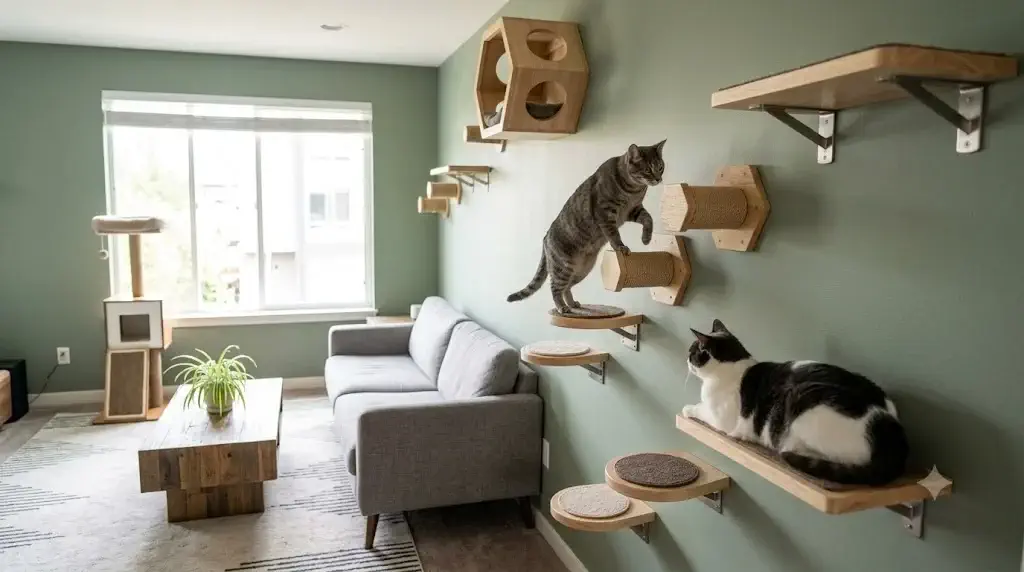
Quick Reference Specification: 5 Best Cat Wall Steps & Climbing Stairs (Budget to Premium)
| Model / System | Step Architecture | Traction & Substrate Spec | Dynamic Load / Weight Rating | Set Configuration | Primary Architectural Fit |
|---|---|---|---|---|---|
| 1. COOLEX 3-in-1 Wall Steps | Rectangular Peg Steps | Natural Wood & Hemp Rope Wrap | 25 lbs (11.3 kg) | 2-Pack Climbing Ledges | Compact vertical steps & scratching perches |
| 2. INICIO Natural Wood Steps | Curved Edge Floating Ledge | Solid Multi-Layer Wood & Sisal Top | Up to 15 lbs (Small Cats) | 3-Pack Staggered Stairs | Kittens & gentle indoor climbing paths |
| 3. HOOBRO 4-Step Stair Units | Integrated Angled Stringer Stair | Oak Finish Wood & Jute Treads | 35 lbs (15.8 kg) | 2-Pack (4 Steps Per Unit) | Rapid continuous climbs & multiple cat access |
| 4. ESPETS White Floating Steps | Modern Floating Wall Peg | Solid Hardwood & Grey Felt Treads | Holds up to 30 lbs | 3-Pack Floating Steps | Minimalist modern interiors & soundless steps |
| 5. FUKUMARU Solid Rubberwood Stair | Large Bidirectional 4-Step Stair | Kiln-Dried Solid Rubber Wood & Jute | 40 lbs (Heavy Cat Tested) | Single Heavy-Duty Stairway | Heavy felines, senior accessibility & stud mounts |
Quick Answer: What Are the Best Cat Wall Steps?
The best cat wall steps incorporate rigid solid timber mounting plates, deep friction-generating sisal wrapping, and multi-screw flanges that withstand downward landing torque. Arranged progressively from accessible starter steps to heavy-duty architectural stairways, the COOLEX 2-pack offers budget-friendly hemp-wrapped steps; the INICIO 3-pack provides curved natural wood stairs for lightweight cats; the HOOBRO 2-pack ladder introduces pre-angled stringers; the ESPETS 3-pack delivers modern white steps with dense felt pads; and the FUKUMARU solid rubberwood stair provides a bidirectional four-step incline built for cats up to 40 lbs.
- Best Budget Starter Steps: COOLEX 3-in-1 Cat Climbing Wall Steps (Dual natural wood perches wrapped with durable hemp rope for reliable claw traction).
- Best Small-Cat Stepping Ledges: INICIO Cat Wall Steps 3-Pack (Smooth rounded natural wood ledges designed for kittens and cats up to 15 lbs).
- Best Pre-Angled Continuous Ladder: HOOBRO 2-Pack Four-Step Cat Ladder (Solid oak-toned frame with four jute-wrapped steps per unit).
- Best Modern Minimalist Wall Steps: ESPETS Set of 3 White Floating Steps (Solid hardwood construction lined with quiet, non-slip grey felt treads).
- Best Heavy-Duty Architectural Stair: FUKUMARU Cat Climbing Shelf Wall Mounted (Premium solid rubberwood construction with natural jute-wrapped steps, tested to 40 lbs).
To connect these vertical climbing paths into complete aerial circuits, see our tested recommendations for the best cat wall bridges.
Vertical Climbing Steps Protect Feline Carpal Joints from Impact Stress
Intermediate wall steps reduce vertical jumping drops from exceeding the safe feline landing threshold of 36 inches. Without intermediary climbing pegs, domestic cats leaping downward from high shelves absorb up to 4.5 times their body weight in ground reaction force across their front paws and carpal joints:
Deceleration Force Control
Staggered 8-to-12-inch step intervals distribute landing deceleration across multiple muscle groups, preventing chronic front leg arthritis and tendon hyperflexion.
Claw Fiber Engagement
Jute and sisal wraps allow feline claws to mechanically interlock with fibers, generating maximum upward propulsion during vertical dashes.
Cantilever Shear Mechanics
Dynamic landing energy exerts sudden rotational leverage at the wall bracket, necessitating steel screws anchored firmly into 2×4 framing lumber.
Top 5 Best Cat Wall Steps Reviewed (Low to High Tier)
Engineering evaluations isolate step bracket thickness, screw shear resistance, and surface friction coefficients. Below is an architectural breakdown of the top five best cat wall steps tested for high-traffic feline highway systems, arranged progressively from budget options to premium solid hardwood:
1. COOLEX 3-in-1 Cat Climbing Wall Steps with Hemp Rope
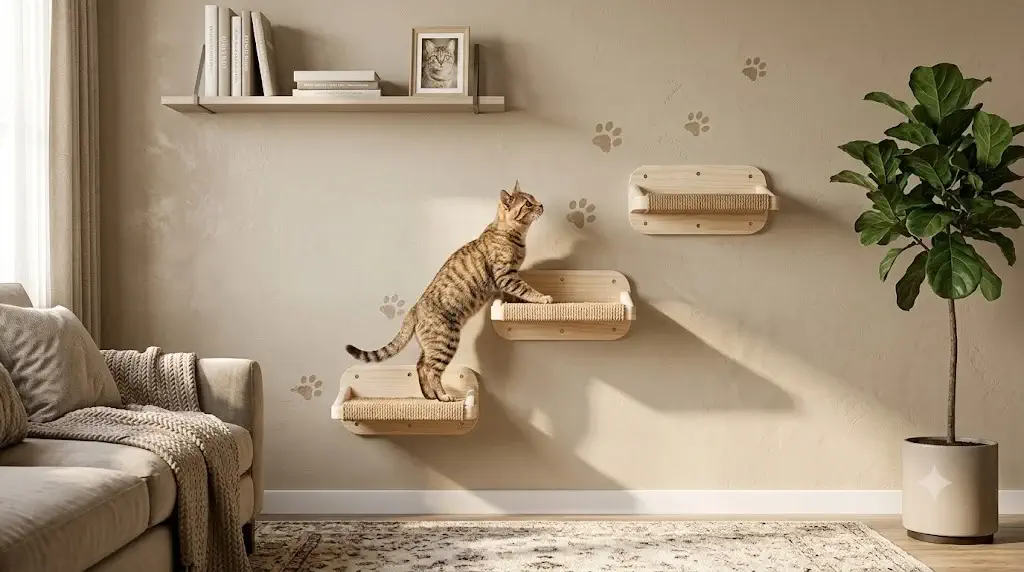
Specs: Material: Natural Wood & Hemp Rope Wrap | Form Factor: Rectangular Cantilever Ledges | Dynamic Capacity: 25 lbs | Hardware: Multi-Point Backing Flange
The COOLEX 3-in-1 Cat Climbing Wall Steps deliver practical vertical access without straining your budget. Each solid wood step is wrapped in thick hemp rope, serving as both a stable stepping platform and an elevated scratching pad. The wide mounting backplate distributes feline landing forces across drywall anchors or wall studs.
- Pros: Solid natural timber build; heavy hemp rope wrap offers dependable claw traction; affordable entry into vertical wall systems.
- Cons: Hemp rope may fray after months of intense scratching and require re-wrapping.
2. INICIO Cat Wall Steps – 3 Pack of Stairs for Cats to Climb
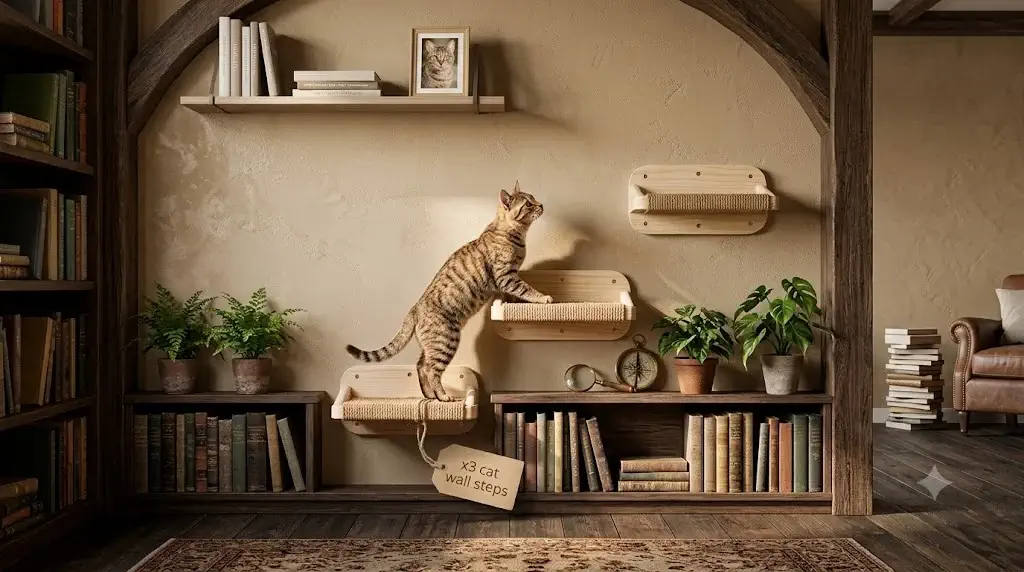
Specs: Material: Natural Multi-Layer Wood & Textured Tread | Set: 3 Independent Wall Steps | Weight Limit: Up to 15 lbs | Profile: Smooth Chamfered Corners
The INICIO Cat Wall Steps 3-Pack is designed specifically for smaller cats and kittens learning to navigate vertical space. Milled with rounded bullnose edges to prevent impact scrapes, these compact wooden stairs feature a textured top surface that provides non-slip footing. The staggered 3-piece layout allows owners to customize rise and run distances.
- Pros: Smooth rounded corners protect paws during rapid play; lightweight multi-pack offers flexible arrangement; clean natural wood appearance.
- Cons: 15-lb weight limit makes it unsuitable for large breeds like adult Maine Coons.
3. HOOBRO 2 Pack Cat Wall Shelves with Four Jute Scratching Steps
Specs: Structure: 2 Pre-Angled Stringer Units (4 Steps Each) | Material: Oak-Toned Engineered Wood & Jute | Capacity: 35 lbs | Mounting: Top and Bottom Stud Brackets
The HOOBRO 2-Pack Cat Wall Stair Set simplifies vertical wall layout by mounting four staggered steps on a single continuous wooden stringer. Instead of measuring individual heights for eight separate pegs, owners simply anchor the top and bottom plates into wall studs. Each tread is wrapped in natural jute rope to give claws dependable grip during rapid upward sprints.
- Pros: Two complete 4-step ladders in one kit; unified stringer design reduces wall drilling points; durable jute-wrapped steps resist wear.
- Cons: Fixed step angle cannot be customized for cats with specific stride limitations.
4. ESPETS Set of 3 White Cat Wall Climbing Steps
Specs: Material: Solid Hardwood Frame (White Finish) & Felt Inlay | Set: 3 Wall Mount Floating Shelves | Holding Strength: Up to 30 lbs | Fasteners: 3-Hole Reinforced Rear Flange
The ESPETS 3-Piece White Floating Step Set combines sleek contemporary styling with feline joint protection. Coated in a durable semi-gloss white finish and fitted with dense grey felt treads, these steps eliminate claw clicking and prevent slipping on slick wood. Their triangular under-bracket bracing delivers steady cantilever resistance during vigorous downward leaps.
- Pros: Contemporary white painted finish blends with modern home decor; sound-dampening felt pads absorb landing noise; robust triangular support bracing.
- Cons: Felt pads collect shedding fur and need periodic vacuuming.
5. FUKUMARU Cat Climbing Shelf Wall Mounted, Large 4-Step Stair
Specs: Material: 100% Kiln-Dried Solid Rubber Wood & Natural Jute | Structure: Large 4-Step Bidirectional Stair | Tested Load: 40 lbs | Mounting: Heavy-Duty Wood Screws
For heavy adult cats and multi-cat households demanding zero flex, the FUKUMARU Solid Rubber Wood Climbing Stair represents the benchmark in feline structural engineering. Milled from dense Malaysian rubberwood and wrapped with thick jute rope on every tread, this four-step unit mounts bidirectionally (left-to-right or right-to-left). It anchors solidly into wall studs, effortlessly holding large felines up to 40 lbs.
- Pros: Solid kiln-dried rubberwood will not crack or warp; bidirectional mounting orientation fits any wall layout; generous 40-lb verified load rating.
- Cons: Larger overall footprint requires dedicated wall space near structural framing studs.
Step Spacing Measurements Dictate Feline Ascent Ergonomics and Safety
Proper step spacing prevents physical hesitation and dangerous mid-air overextensions during vertical climbs. When configuring the best cat wall steps on drywall, maintain precise horizontal and vertical distances tailored to your cat’s age and mobility:
| Feline Profile / Physical Category | Optimal Vertical Rise | Optimal Horizontal Run | Ascent Incline Angle |
|---|---|---|---|
| Athletic Young Adults (Agile Climbers) | 10.0 to 12.0 Inches | 10.0 to 12.0 Inches | 45° (Balanced Ascent) |
| Large Breeds (Maine Coon, Ragdoll) | 8.0 to 10.0 Inches | 12.0 to 14.0 Inches | 35° to 40° (Gentle Run) |
| Senior / Arthritic Cats (Mobility Issues) | 6.0 to 7.0 Inches | 8.0 to 10.0 Inches | 30° to 35° (Low Impact) |
For detailed step-by-step layouts and mathematical formulas, consult our guide on cat wall furniture weight capacity.
Stud Fasteners Counteract Downward Cantilever Rotational Torque
Fastening cat climbing pegs directly into residential wall studs prevents catastrophic drywall blowout. Because a cat leaping onto an 11-inch peg multiplies landing force through rotational cantilever leverage, standard plastic anchors will pull through 1/2-inch gypsum drywall over time:
- Locate Framing Stud Centers: Use a magnetic or electronic stud finder to locate the exact center of 2×4 framing studs behind the drywall.
- Mark Staggered Elevation Points: Mark ascending step positions at 8-to-12-inch vertical increments using a pencil and measuring tape.
- Bore 2.5-Inch Pilot Holes: Drill into the center of the wooden studs using a 1/8-inch high-speed twist bit to avoid splitting the timber.
- Drive #10 Structural Screws: Secure the mounting flange with heavy-duty structural wood screws measuring at least 2.5 to 3.0 inches in length.
- Perform Static Weight Verification: Apply downward hand pressure equivalent to 30 lbs on the step edge to verify zero bracket deflection before feline use.
For a complete photographic walkthrough of finding studs and drilling anchor holes, visit our guide on how to install cat wall shelves.
Selecting Quality Cat Steps Requires Six Structural Checkpoints
Systematic hardware inspections ensure cat climbing steps provide safe footing and long-term durability. Verify these six engineering criteria before selecting the best cat wall steps for your home:
- Solid Core Timber: Choose solid rubberwood, pine, or multi-ply hardwood over hollow plastic cores.
- High-Traction Wrapping: Ensure surfaces incorporate natural jute cordage, sisal rope, or sound-absorbing dense felt.
- Cantilever Load Rating: Verify published dynamic holding capacity of at least 25 to 40 lbs per individual step.
- Multi-Screw Flange: Look for mounting plates with vertically stacked screw holes that distribute torque along the stud.
- Adequate Tread Depth: Ensure steps extend at least 7 to 10 inches from the wall to give paws ample landing room.
- Safe Rounded Corners: Verify edges feature chamfered or rounded profiles to prevent bruising during high-speed leaps.
For master vertical system rankings and complete room planning, browse our foundational review of the best cat wall shelves.
Frequently Asked Questions About the Best Cat Wall Steps
How far apart should the best cat wall steps be installed?
For healthy adult cats, install steps 8 to 12 inches apart vertically and 10 to 14 inches horizontally. For senior cats or kittens, reduce vertical spacing to 6 to 8 inches to minimize joint strain.
Can cat wall steps be installed on drywall without studs?
No, installing climbing steps directly into drywall with standard plastic anchors is unsafe. Leaping creates significant cantilever leverage that easily rips anchors out of drywall; steps must be driven into wooden framing studs or secured with heavy-duty steel toggle bolts.
Are jute rope steps or felt-padded wooden steps better for cats?
Jute and sisal rope steps provide superior claw grip for high-energy climbers and double as scratching surfaces. Felt-padded steps offer a sleek, quiet modern design that feels comfortable on paws while eliminating claw noise.
How do you teach a cat to use wall climbing steps?
Lure your cat onto the lowest step using high-value treats, catnip spray, or a feather wand. Never force your cat onto elevated steps; allow them to investigate the textured surfaces and test footing stability at their own pace.
