
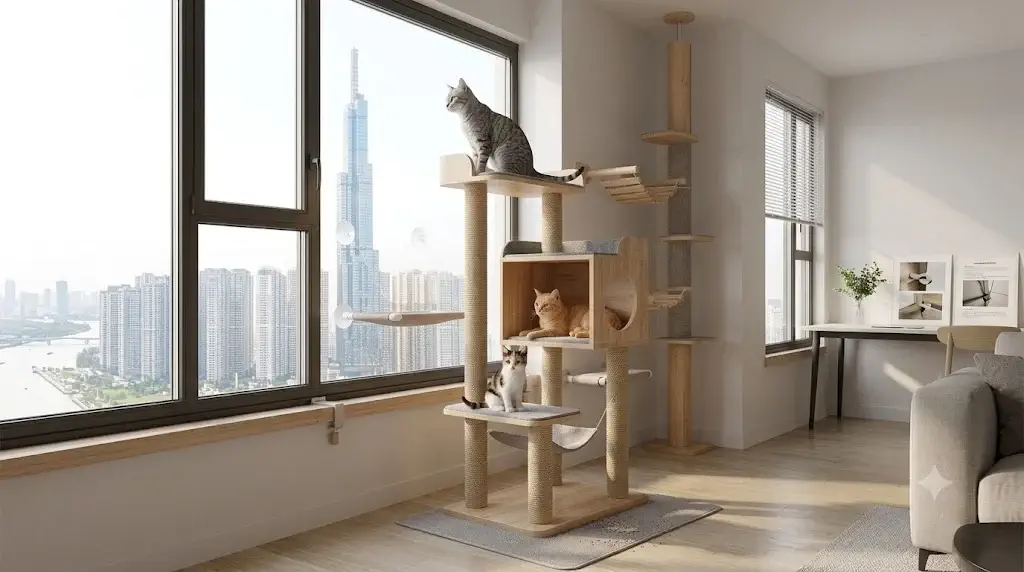
Best Cat Furniture for Renters (2026 Guide)
The best cat furniture for renters delivers multi-level climbing, scratching, and observation zones through freestanding, non-destructive designs that preserve 100% of residential security deposits. When rental agreements prohibit drywall anchors or permanent structural modifications, feline caregivers must balance vertical territory expansion with zero-damage reversibility. Selecting high-grade renter cat furniture requires auditing floor-load stability, evaluating tension-pole spring compression, verifying no-drill window clamp ratings, and choosing non-marking contact pads across delicate hardwood, vinyl, and drywall substrates.
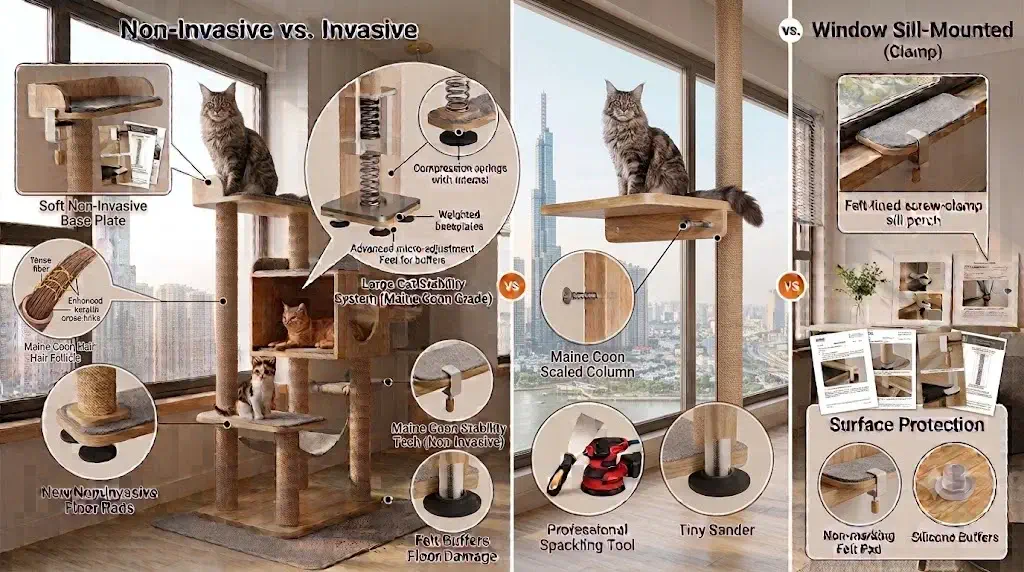
Quick Reference Specification: Renter Structural Matrix & Non-Invasive Mounting Benchmarks
| Architectural Category | Substrate Interface | Installation Requirement | Deposit Risk Profile | Structural Load Rating | Target Renter Application |
|---|---|---|---|---|---|
| Freestanding Multi-Tier Tree | Floor contact only | Zero drilling / Free placement | Zero risk (100% reversible) | 45+ lbs dynamic shear | Multi-cat standard apartments |
| Tension Compression Tower | Floor-to-ceiling joist | Spring-loaded expansion rod | Low (check ceiling scuffs) | 30 lbs per stepping tier | Ultra-narrow micro studios |
| No-Drill Window Perch | Sill clamp / Window glass | Felt-lined screw clamps | Near-zero (non-marking pads) | 40 lbs static weight | Elevated sunny enrichment |
| Heavy-Base Scratching Column | Floor surface | Pre-assembled standalone | Zero risk | 35 lbs horizontal pull | Door trim & carpet protection |
| Over-The-Door Modular Track | Standard interior door slab | Top & bottom steel bracket clamps | Zero risk (requires felt lining) | 30 lbs distributed | Tight closets & bedroom doors |
Quick Answer: What Is the Best Cat Furniture for Renters?
Freestanding wide-base cat trees represent the best overall cat furniture for renters because they establish independent vertical climbing and scratching territory without penetrating walls or causing deposit forfeitures. For apartments with constrained floor footprints, spring-loaded floor-to-ceiling tension towers provide continuous vertical reach up to nine feet without screws, while clamp-on window perches turn existing sills into sunlit observation loungers without drilling. Renters must systematically avoid screw-in wall shelves and aggressive chemical adhesive brackets unless specific lease riders explicitly authorize drywall patching upon departure.
To evaluate specific freestanding units calibrated for ultra-tight floor plans under two square feet, read our engineering teardowns in the best cat furniture with minimal floor footprint guide.
| Rental Housing Priority | Recommended Furniture Category | Mechanical Security Rationale |
|---|---|---|
| Strict No-Alteration Clause | Wide-Base Freestanding Wood Tree | Zero wall, ceiling, or window contact; 100% reversible. |
| Compact Studio Living | Floor-to-Ceiling Spring Tension Pole | Uses 1.1 sq ft of floor area while utilizing vertical clearance. |
| Outdoor Visual Enrichment | Clamp-On Sill Window Perch | Attaches via felt-lined thumb screws without puncturing woodwork. |
| Carpet & Baseboard Preservation | Heavy Cast-Iron or Wood Base Scratcher | Redirects clawing abrasion away from landlord property. |
| Zero Floor Space Layouts | Over-The-Door Multi-Tier Climber | Hangs over interior doors with zero floor displacement. |
Top Renter-Friendly Cat Furniture Categories: Evaluated Performance
Renter furniture categories separate by their mechanical contact methods and surface preservation capabilities. These five verified architectural archetypes eliminate permanent structural alterations while maintaining feline stability:
1. Freestanding Multi-Level Cat Tree — Best Overall Renter Solution
Best for: Complete multi-functional territory with zero landlord friction or move-out repair work.
Freestanding multi-level towers stand as the definitive zero-risk installation for tenant households. By consolidating vertical climbing steps, enclosed sleeping cubbies, padded perches, and natural sisal scratching columns into a self-supporting timber frame, the unit eliminates wall contact entirely. Modern engineering integrates dense composite or solid wood base slabs that keep the center of gravity near the floor, ensuring structural stability during rapid feline descents.
- Substrate Impact: 100% isolated to floor contact; leaves walls and mouldings completely untouched.
- Functional Density: Houses sleeping, claw maintenance, and high vantage zones on one footprint.
- Move-Out Logistics: Breaks down via standard hex-bolts into flat cartons for straightforward relocation.
Avoid it if: Your residential floor space is so restricted that walking corridors become blocked.
2. Floor-to-Ceiling Tension Cat Tower — Best Small-Apartment Vertical Highway
Best for: Studios and narrow apartments needing maximum climbing height with zero wall penetrations.
Tension-mounted climbing columns utilize internal industrial compression springs to brace an upright pillar between floor and ceiling joists. This mechanism allows indoor cats to scale eight to nine feet vertically within a minimal 1.1-square-foot ground area. Top-tier tension poles feature non-marking silicone or rubberized expansion plates that distribute mechanical pressure evenly against ceiling drywall, preventing surface indentation or paint peeling.
- Ceiling Interface: Rubberized pressure flange eliminates screw holes, wall anchors, and drywall dust.
- Vertical Geometry: Provides 5 to 6 stacked climbing waypoints along a single narrow vertical axis.
- Substrate Verification: Requires solid wood ceiling joists or flat drywall; incompatible with drop-ceilings.
Avoid it if: Your apartment features slanted loft ceilings, popcorn textures, or suspended acoustic tiles.
3. Clamp-On & Sill-Mounted Window Perches — Best Zero-Footprint Lounger
Best for: Creating sunny outdoor viewing perches without consuming valuable floor surface area.
No-drill window perches expand feline territory by repurposing existing architectural window structures. Unlike older models that required wood screws driven into window frames, modern renter-safe units utilize cantilever wooden support legs and felt-padded thumb-screw clamps that grip the sill apron cleanly. This design directs feline weight downward into the structural sill rather than pulling outward, supporting active adult cats up to 40 lbs without scratching painted woodwork.
- Fastener Technology: Dual padded compression clamps adjust to various sill depths without tools.
- Ground Displacement: Zero square feet of conventional floor space consumed.
- Structural Security: Far more dependable than rubber suction cups that degrade under thermal changes.
Avoid it if: Your apartment windows lack projecting interior sills or feature fragile vinyl lips.
4. Heavy-Base Freestanding Scratching Post — Best Rental Asset Protection
Best for: Safeguarding landlord carpets, door frames, and upholstered baseboards from claw marks.
Freestanding scratching pillars serve as essential defensive fixtures for apartment security deposit preservation. A solid scratching post measuring 32 to 36 inches tall allows an adult cat to stretch out fully and shed outer claw husks cleanly. By pairing a thick sisal column with a heavy, weighted baseplate, the fixture absorbs dynamic pulling forces without sliding across polished hardwood or tipping onto walls.
- Property Defense: Positioned adjacent to vulnerable sofa corners or door trim to redirect clawing.
- Chassis Stabilization: Weighted wood or cast-iron base eliminates structural wobble during scratching.
- Surface Protection: Underside rubber bumper feet prevent finish dulling on parquet and vinyl planks.
Avoid it if: Your cat demands high vertical sleeping perches above eye level.
5. Over-The-Door Modular Cat Climber — Best Zero-Floor Space Saver
Best for: Micro-apartments, closets, and bedroom doors needing vertical perches with zero floor impact.
Over-the-door hanging cat climbers convert standard interior door slabs into multi-tiered climbing gyms without drilling screws into wood trim. Utilizing heavy-duty powder-coated steel top brackets lined with protective felt padding, the unit anchors securely over standard 1-3/8″ or 1-3/4″ residential doors. Tension strap anchors at the bottom edge prevent lateral swinging when doors open, giving cats 3 to 4 stepping levels while leaving hallway floors completely open.
- Zero Floor Footprint: Suspends entirely from the door slab, preserving 100% of room walkways.
- Non-Marking Clamps: High-density felt lining prevents metal-on-paint friction and scratches.
- Collapsible Shelves: Perch platforms fold up flush against the door when not in use.
Avoid it if: Your rental doors have less than 1/8″ clearance along the top frame or lack solid core weight.
What Makes Cat Furniture Truly Renter-Friendly?
Renter-friendly cat furniture combines complete physical reversibility with independent structural stability across five primary building surfaces. Marketing claims that advertise “no tools needed” often obscure structural risks like adhesive paint stripping or unstable frames that tip during normal use. True tenant-safe furniture functions reliably without leaving permanent marks on rental infrastructure:
- Wall Surfaces: Eliminates plastic toggle anchors, drywall screw holes, and adhesive mounting strips.
- Flooring Substrates: Incorporates felt glides or broad rubber bumpers to prevent scratching hardwood floor coats.
- Window Assemblies: Clamps securely via felt buffers without fracturing glass or denting vinyl frames.
- Door Enclosures: Hangs using felt-padded steel brackets that do not impede normal latching operations.
- Ceiling Joists: Distributes spring compression loads via broad flanges that leave no indentation rings.
For a complete understanding of how to configure furniture within tight floor plans, see our room-level strategies in best cat furniture for small apartments.
Are Wall-Mounted Cat Shelves Practical for Rental Apartments?
Wall-mounted cat shelves remain viable for renters only when leases permit minor fastener holes and tenants master standard drywall spackling. While many landlords forbid large wall anchors, standard wood stud screws leave clean, 1/8-inch puncture holes that can be patched with spackling paste and sandpaper in under 20 minutes at move-out. However, if your lease agreement contains a strict no-alteration rider, installing wall-mounted systems risks security deposit deductions.
To review the tools and techniques required to anchor shelves safely into studs, read our master tutorial on how to install cat wall shelves.
Why Adhesive-Mounted Cat Shelves Fail Rental Standards
Adhesive-mounted cat shelves fail rental durability standards because dynamic jumping impacts peel interior latex paint off gypsum cores. While adhesive strips support static vertical loads when tested under laboratory conditions, an active cat bounding onto a platform creates outward rotational torque. This cantilever moment tears the paper backing off the drywall, leaving large patches of damaged wall that cost far more to repair than a clean screw hole.
How to Protect Rental Property Surfaces From Cat Damage
Strategic furniture placement protects rental flooring, door trims, and carpet transitions from destructive scratching behaviors. Domestic felines scratch to mark visual territory and shed claw sheaths; directing this natural drive requires positioning dedicated scratch outlets where scratching already occurs:
- Intercept Doorway Markings: Place a tall vertical scratching column adjacent to bedroom doors to prevent fraying of hallway carpets.
- Buffer Hardwood Floors: Adhere dense felt pads beneath all wooden cat tree baseplates to prevent grit from scouring floor polyurethane coats.
- Shield Window Trim: Install sill perches fitted with non-marking silicone pads to stop claws from digging into painted wood aprons.
- Document Move-In Conditions: Photograph all existing carpet seams, door trims, and walls before assembling cat furniture to establish baseline proof.
If your freestanding cat tree exhibits minor base sway on rental carpets, apply the corrective measures detailed in our guide on how to stop a cat tree from wobbling.
Renter Freestanding Furniture vs. Permanent Wall-Mounted Systems
Freestanding furniture trades slight floor space consumption for complete portability and zero move-out restoration duties. While wall-mounted catwalks clear floor pathways entirely, they demand structural drilling, stud finding, and move-out repainting. Understanding these trade-offs helps renters make informed choices:
| Performance Metric | Renter Freestanding Systems | Permanent Wall-Mounted Fixtures |
|---|---|---|
| Lease Risk Profile | 100% compliant with standard leases | Conditional upon landlord authorization |
| Move-Out Workload | Zero minutes (disassemble and pack) | 1 to 2 hours of spackling, sanding, and painting |
| Floor Footprint Consumption | 1.1 to 3.5 sq ft of floor area | 0.0 sq ft (entirely suspended overhead) |
| Relocation Adaptability | Fits any future apartment room layout | Requires matching wall framing at next home |
If your landlord approves drywall fasteners and you want zero floor footprint, explore tested platforms in our best wall-mounted cat furniture guide.
The 6 Common Mistakes Renters Make With Cat Furniture
Avoiding common selection errors ensures renter furniture remains structurally safe while keeping deposits intact. Make sure to avoid these six frequent tenant oversights:
- Trusting Adhesive Shelves: Believing sticky pads can handle dynamic jumping forces leads to fallen cats and torn drywall paper.
- Buying Narrow Trees Without Base Ballast: Selecting lightweight towers without solid wood baseplates creates dangerous sway that frightens cats.
- Over-Tightening Ceiling Tension Rods: Forcing spring rods too aggressively can puncture plasterboard or crack ceiling skim coats.
- Neglecting Floor Buffer Pads: Allowing raw screw heads or unpadded particle board to rub against hardwood damages floor polyurethane.
- Using Incompatible Window Perches: Installing clamp perches on sills too shallow to seat the brackets can lead to unexpected bracket release.
- Ignoring Anti-Tip Wall Straps for Tall Trees: Skipping safety anchors on tall carpeted towers in homes with heavy cats introduces unnecessary tipping risks.
Decision Guide: Which Renter Cat Furniture Matches Your Space?
Matching rental furniture to your specific apartment depends on lease restrictions, room dimensions, and feline body mass. Use this decision guide to select the right system for your home:
| Your Rental Living Reality | Optimal Furniture Category | Recommended Placement Strategy |
|---|---|---|
| Strict no-drilling clause in studio | Floor-to-Ceiling Spring Tension Pole | Position in narrow corner between desk and wardrobe. |
| Multi-cat household on carpet | Wide-Base Freestanding Wood Tower | Position flush against an open living room wall span. |
| Cats scratching hallway baseboards | Heavy Cast-Iron Base Sisal Post | Set directly in front of targeted trim boards. |
| Sunny bedroom with deep window sills | Clamp-On Sill Window Perch | Secure thumb clamps with felt pads for birdwatching. |
| Zero floor space micro-bedroom | Over-The-Door Modular Climber | Hang over closet or interior bedroom door. |
Final Verdict: Building a Worry-Free Renter Cat Setup
The best cat furniture for renters provides comprehensive feline enrichment while leaving rental surfaces in clean, original move-in condition. For most tenants, a freestanding multi-level cat tree with a heavy base provides the ideal foundation, delivering exercise and sleep areas without wall contact. Complementing this tower with a clamp-on window perch, a door-hanging climber, and an isolated scratching post gives cats full vertical variety without risking security deposit deductions.
Successful apartment living with cats does not require drilling through drywall. By prioritizing freestanding stability, padded clamps, and weighted bases, renters can give indoor cats enriching vertical territory while keeping property managers satisfied.
Frequently Asked Questions (FAQ)
What is the best cat furniture for renters?
A stable freestanding multi-level cat tree is the best overall solution for renters because it provides climbing, scratching, and elevated resting zones without requiring wall anchors or leaving surface damage.
Can renters install wall-mounted cat shelves?
Renters can install wall-mounted shelves if their lease allows minor fastener holes and they patch the 1/8-inch screw holes with spackling paste and sandpaper before move-out inspections. If the lease strictly forbids wall drilling, use freestanding furniture instead.
Are adhesive-mounted cat shelves safe for apartments?
No, adhesive-mounted cat shelves are unsafe for cats and rental walls. The dynamic force of a jumping cat pulls the top layer of paint and drywall paper off the wall, creating structural failure and expensive drywall repairs.
Are floor-to-ceiling tension towers safe for rental ceilings?
Yes, tension towers are safe when anchored against solid ceiling framing joists using wide, rubberized pressure flanges. They should not be used on drop-tile ceilings or popcorn plaster finishes that crumble under compression.
How do renters protect hardwood floors from cat tree scratches?
Adhere commercial heavy-duty felt furniture pads beneath all corners of the cat tree’s baseplate, and place an anti-slip woven rug underneath to catch loose litter grit before it grinds into the floor finish.
