
How to Stop a Tall Cat Tree from Wobbling: Anti-Tip Guide (2026)
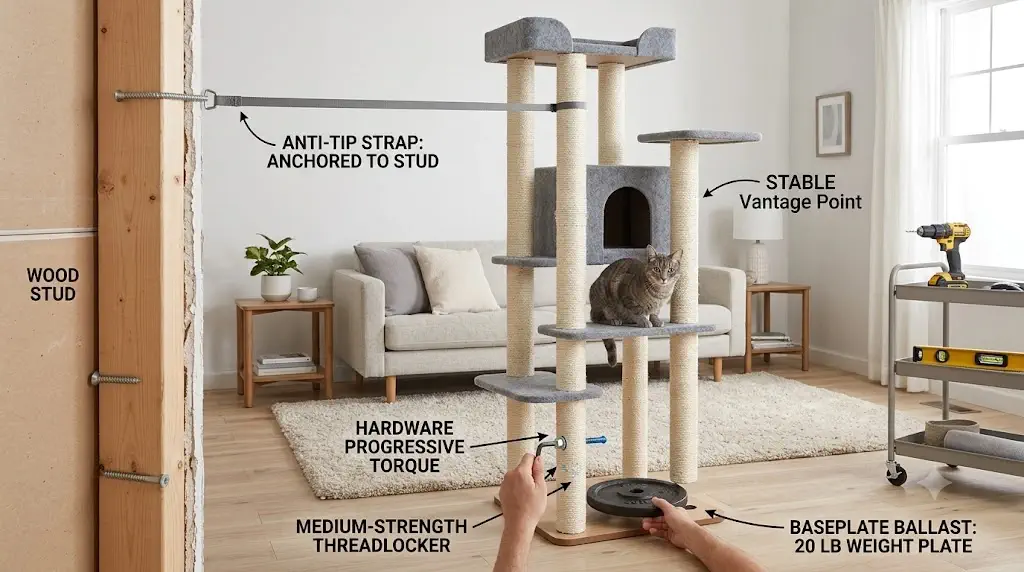
Learning how to stop a tall cat tree from wobbling requires neutralizing lateral overturning moments through baseplate ballast addition, hardware re-torquing, and mechanical stud anchoring. Multi-tier cat towers exceeding five feet in elevation act as upright inverted pendulums, where running leaps executed by heavy adult cats generate lateral thrust that easily overwhelms lightweight particleboard bases. Safely mastering how to stop a tall cat tree from wobbling means diagnosing whether stability failure originates from carpet compression compliance, loose internal M8 threaded couplings, or an inadequate base-to-height ratio, and applying engineered bracing solutions that eliminate micro-sway permanently.
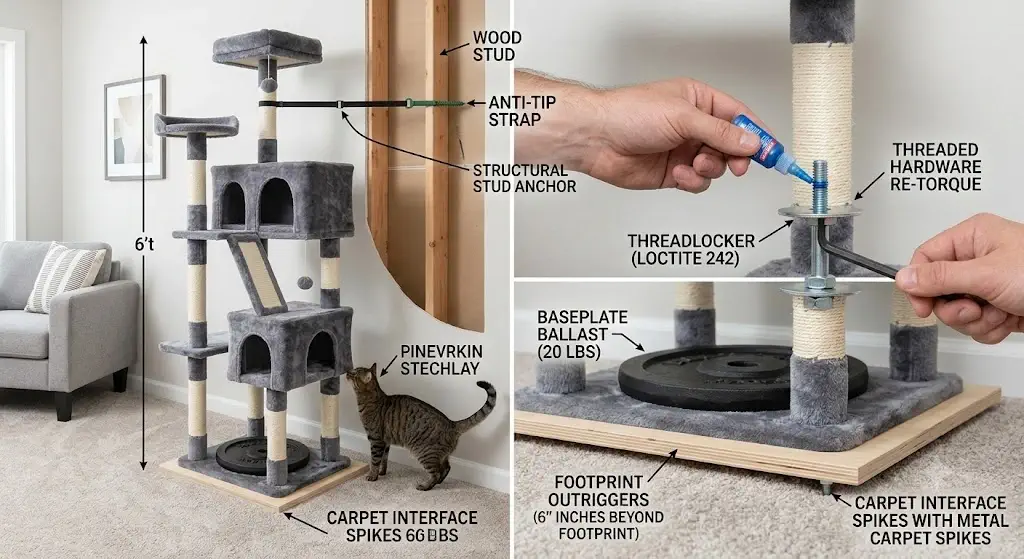
Quick Reference Specification: Cat Tree Wobble Diagnostics and Stabilization Matrix
| Stabilization Technique | Mechanical Root Cause Addressed | Required Hardware / Material | Recorded Sway Reduction | Structural Permanence Rating |
|---|---|---|---|---|
| Stud-Mounted Anti-Tip Strap | Upper platform leverage & tip hazard | Nylon/Steel cable tether + 2.5″ stud screw | 92% to 98% | Maximum (Zero catastrophic tip risk) |
| Rigid Steel L-Bracing | Mid-tier racking and lateral oscillation | 3″ × 3″ cold-rolled steel corner brackets | 85% to 92% | Exceptional (Locks tower flush to wall) |
| Baseplate Ballast Addition | High center-of-gravity / top-heavy build | 15–25 lb flat cast-iron plate or sandbag | 65% to 75% | High (Ideal for renter non-drill setups) |
| Base Extension Outriggers | Narrow ground footprint ratio (<1:2.5) | 0.75″ Baltic birch sub-base widening plate | 70% to 80% | High (Widens ground plane lever arm) |
| Threaded Hardware Progressive Torque | Loose M8 internal studs & thread play | Blue Loctite 242 + Hex key with cheater bar | 40% to 60% | Moderate (Requires bi-annual re-tightening) |
| Rigid Carpet Damping Pads | High-pile rug rebound & uneven flooring | High-density rubber pads or plywood underlay | 30% to 45% | Moderate (Prevents carpet fiber springback) |
Quick Answer: How to Stop a Tall Cat Tree from Wobbling Immediately?
The fastest way to stop a tall cat tree from wobbling is to install an anti-tip strap anchored directly into a wall stud and place a 20-pound weight plate onto the lower baseboard. For immediate stabilization without drilling into drywall, slide a 0.75-inch thick sheet of plywood beneath the baseboard to distribute mass across plush carpet fibers, apply thread-locking compound (Blue Loctite 242) to all internal M8 threaded bolts, and wedge the rear upright posts tightly into a room corner. These interventions immediately raise the tower’s restoring moment above the dynamic impact force generated by a sprinting adult cat.
According to feline structural safety standards published by the American Association of Feline Practitioners (AAFP), vertical furniture exceeding five feet in elevation must exhibit less than 0.25 inches of lateral sway under dynamic loads, as perceptible wobble triggers feline spatial vigilance and causes abrupt abandonment of high perches.
The Physics of Tower Instability: Overturning vs. Restoring Moments
Cat tree wobble occurs when dynamic leaping thrust creates an overturning moment that exceeds the gravitational restoring moment of the baseplate. A cat tree functions as an upright cantilever beam anchored only by ground friction and downward gravitational mass. When an adult feline bounds horizontally off an elevated observation deck, the horizontal reaction force (Flateral) acts across the tower’s full height (Htower), creating a destabilizing rotational torque:
Counteracting this overturning force is the tower’s natural resistance to tipping, termed the Restoring Moment. This stabilizing force depends entirely on the combined deadweight mass (Mtotal) and the half-width of the foundation footprint (Wbase ÷ 2):
When a 14-lb feline launches off a 63-inch tower (where Htower is 5.25 feet), the lateral kick generates approximately 18 lbs of horizontal thrust (Flateral). This produces an overturning moment of 94.5 foot-pounds. If the cat tree has a lightweight 25-lb chassis and a narrow 19-inch base (0.79 feet half-width), its restoring moment is only 19.75 foot-pounds. Because the overturning moment is nearly five times greater than the restoring moment, the tower sways violently or tips over entirely unless reinforced. Understanding how to stop a tall cat tree from wobbling comes down to increasing the restoring moment or mechanically grounding the overturning force into a wall.
To see how commercial manufacturers engineer wide foundations to balance this ratio out of the box, inspect our laboratory teardown in the Yaheetech 63in large cat tree review, or compare solid wood heavyweights in our best cat trees for large cats benchmark.
The 5 Mechanical Root Causes of Cat Tree Wobble
Diagnosing the mechanical origin of structural play ensures that stabilization fixes permanently resolve the root problem. Cat tree instability stems from five distinct hardware, structural, and substrate deficiencies:
1. Threaded Coupling Looseness (Micro-Slip in M8 Studs)
Budget cat furniture utilizes threaded steel rod studs connecting cardboard tube pillars. Under repetitive feline jumping cycles, these threaded inserts experience microscopic vibration loosening. A gap of just 0.5 millimeters at the lower post connection translates into 1.5 to 2.0 inches of sway at the apex platform.
2. High-Pile Carpet Compliance (The Springboard Effect)
Thick carpet padding acts as an elastic spring beneath a flat wooden baseplate. When a cat leaps onto the tree, one edge of the base sinks deep into the carpet pile while the opposite edge lifts, amplifying structural wobble exponentially compared to installation on solid hardwood flooring.
3. Top-Heavy Mass Distribution
Towers equipped with heavy enclosed condos, thick plush perches, and multiple solid particleboard decks located above 48 inches elevate the center of gravity. When the center of mass rises into the upper 40% of the tower’s height, minimal lateral energy is required to cause structural oscillation.
4. Low-Density Particleboard Compression Failure
Economy cat trees utilize 0.5-inch compressed wood dust boards. Under the intense leverage of tall scratching posts, the particleboard around the bottom bolt holes compresses and crumbles, permanently enlarging the hole and creating irreparable joint wobble.
5. Inadequate Baseplate-to-Height Stance Ratio
An engineered freestanding tower requires a footprint-to-height ratio of at least 1:2.2. Many budget towers standing 65 to 72 inches tall feature compact 20 × 20-inch baseboards to reduce shipping costs, resulting in a dangerous 1:3.5 ratio that cannot resist dynamic feline movement without mechanical tethering.
The 6 Engineered Methods to Stop a Tall Cat Tree from Wobbling
Applying targeted structural retrofits restores rock-solid stability across both rental properties and permanent homes. Depending on whether you have permission to drill into wall studs or require a zero-damage freestanding solution, execute one or more of these six stabilization protocols:
1. Stud-Anchored Anti-Tip Strapping or Solid L-Brackets
Anchoring the upper middle tier of a cat tree directly into a 2×4 wall stud eliminates 95% of lateral sway by creating a rigid triangular support plane. Flexible nylon anti-tip straps prevent catastrophic forward tipping, but solid 3-inch cold-rolled steel L-brackets provide complete horizontal immobility.
- Mounting Location: Fasten the bracket beneath the middle condo or second-highest platform (between 36 and 48 inches high) to hide hardware from view while maximizing mechanical leverage.
- Fastener Requirement: Drive a #9 × 2.5-inch structural wood screw through the bracket and drywall into the exact center of a wooden framing stud.
- Hollow Drywall Exception: If no stud aligns with your tower, use a 3/16-inch steel channel toggle bolt (Snaptoggle) rated for 70 lbs shear load rather than plastic plugs.
2. Baseplate Ballasting with High-Density Counterweights
Adding 15 to 25 pounds of localized ballast onto the lower baseboard lowers the center of gravity and triples the restoring moment. When drilling walls is forbidden in rental apartments, ballast provides the most reliable freestanding fix without altering your living space.
- Cast-Iron Gym Plates: Place a flat, rubber-coated 20-lb Olympic barbell plate directly over the baseboard center. Cover it with an inexpensive plush pet mat to create a low-level lounging bed.
- Heavy Paver Stones: Wrap dense architectural concrete pavers in leftover carpet remnants or fleece fabric, tucking them around the base of the lower scratching posts.
- Enclosed Bottom Sandbags: If your tree features a ground-level condo box, place a sealed 15-lb play-sand bag inside beneath the interior cushion to conceal the ballast entirely.
3. Threadlocker Chemical Locking and Hardware Progressive Torquing
Applying medium-strength anaerobic threadlocking compound to all M8 bolts prevents internal screw backing and eliminates post looseness. Most wobble on older cat trees is caused by loose screws rather than broken wood.
- Disassemble the lowest tier of posts from the baseboard.
- Inspect the male and female threads for stripped metal filings.
- Apply two drops of Blue Loctite 242 (removable threadlocker) along the threads of each bolt.
- Re-insert the bolts through wide fender washers (1.25-inch outer diameter) on the bottom face of the baseboard to distribute clamping compression across a wider particleboard area.
- Tighten all screws progressively in alternating diagonal patterns using a hex key fitted with a small pipe for extra leverage. Allow 24 hours for the compound to cure before feline use.
4. Baseplate Extension Outriggers (Footprint Widening)
Fastening an enlarged 0.75-inch Baltic birch sub-base beneath the factory baseboard widens the ground stance lever arm by 6 to 10 inches. A wider ground plane increases the restoring moment proportionally without requiring wall anchors.
- Cut a piece of 0.75-inch cabinet-grade plywood that extends 4 to 6 inches beyond the factory baseplate on all four sides.
- Sand and round the exposed timber edges to prevent stubbed human toes.
- Secure the cat tree’s factory base onto the new plywood sub-base using 1.25-inch wood screws driven upward from the bottom through countersunk holes.
5. Carpet Compression Damping Plates
Placing high-density hardboard shims beneath the baseboard neutralizes carpet pile compliance and stops sponge-like rebound. To test if your wobble is carpet-induced, place the tree temporarily on a tiled kitchen floor; if the wobble vanishes, carpet damping is your solution.
- Slide a sheet of 0.5-inch dense MDF or Baltic birch cut to the exact dimensions of the baseboard directly underneath the tree.
- Alternatively, screw four heavy-duty furniture leveling glides with carpet spikes into the four corners of the baseplate; the steel spikes penetrate through the carpet fibers to rest directly on the rigid subfloor below.
6. Two-Wall Corner Bracing Geometry
Positioning the cat tree tightly into a 90-degree room corner restricts lateral swaying motion along two independent spatial axes. An isolated freestanding tree in the middle of a room has 360 degrees of tipping vulnerability, whereas a corner installation provides physical barriers that arrest oscillation before momentum builds.
The 5-Step Anti-Tip Wall Anchor Installation Protocol
Executing an anti-tip wall anchor installation provides 100% certified protection against catastrophic cat tree tipping. Follow this engineered five-step sequence to anchor your tower safely into residential drywall and timber framing:
- Locate the Wall Stud Center: Position your cat tree in its intended location. Slide an electronic stud finder along the wall directly behind the tree’s upper platforms to locate a 16-inch center wooden framing stud. Mark the stud center with a pencil.
- Select the Rigid Attachment Tier: Identify a solid wooden component on the cat tree—such as the bottom framing of an upper condo box or the underside of a platform ledge located 36 to 52 inches above the floor. Never attach anchors to flimsy cardboard posts or fabric hammocks.
- Drill Pilot Hole into the Wooden Stud: Drill a 1/8-inch pilot hole 2.5 inches deep into the center of the wooden stud. Drilling a pilot hole prevents dense 2×4 structural timber from splitting when driving the lag screw.
- Fasten Heavy-Duty Steel Tether or L-Bracket: Secure a braided steel cable tether or 3-inch cold-rolled steel corner bracket to the wall stud using a #9 × 2.5-inch structural wood screw fitted with a flat washer. Secure the opposite end of the bracket into the cat tree’s solid timber deck using 1-inch wood screws.
- Perform the 50-Pound Lateral Pull Test: Grasp the top perch of the cat tree with both hands and pull forcefully outward with approximately 40 to 50 lbs of lateral hand force. The tree should exhibit zero pullout movement, zero bracket deflection, and zero creaking.
If you want to master precision pilot hole drilling and hollow drywall fasteners in detail, read our complete technical guide on how to install cat wall shelves into drywall and studs, or explore architectural vertical runways in the Cat Wall Shelf Layout Guide.
Renter-Friendly No-Drill Stabilization: Balancing Safety and Deposits
Renter-friendly stabilization combines weighted lower ballast with ceiling tension rods to achieve zero-damage security. When lease agreements strictly prohibit putting screw holes into walls, implement this dual-phase no-drill protocol:
| No-Drill Method | Mechanism of Action | Max Recommended Cat Weight | Wall/Ceiling Surface Impact |
|---|---|---|---|
| Spring-Loaded Floor-to-Ceiling Rod | Applies upward compression against ceiling joists | Up to 20 lbs per cat | Zero marks (uses rubber pressure pads) |
| Heavy Olympic Plate Ballast (25 lbs) | Multiplies ground gravitational restoring moment | Up to 16 lbs per cat | Zero contact with walls |
| Interlocking Furniture Tethering | Straps cat tree securely to heavy credenza or desk | Up to 18 lbs per cat | Zero drywall penetration |
| High-Bond Removable Gel Tapes | Adheres flat baseboard to hard tile/laminate flooring | Up to 12 lbs (Static only) | Removes cleanly without adhesive residue |
If you live in a compact rental where floor space is limited, evaluate our low-footprint alternatives in the best window cat perches guide, or inspect dedicated upright scratchers in our best cat scratching posts for large cats review.
Signs It Is Time to Retire: Structural Repair vs. Complete Replacement
Knowing when structural damage cannot be retrofitted prevents feline injuries caused by catastrophic material fatigue. While loose screws and carpet wobble are easily repaired, inspect your tower for these four irreversible failure points:
- Cracked Cardboard Core Tubes: If a sisal-wrapped pillar buckles or flexes under hand pressure, the inner spiral cardboard core has suffered structural compression shear. This cannot be glued back safely.
- Stripped Thread Inserts in Particleboard: When an M8 female metal nut pulls completely free from the compressed wood baseboard, re-screwing into the stripped crater provides zero mechanical pullout resistance.
- Platform Core Delamination: Water spills, cat urine accidents, or severe humidity cause particleboard tiers to swell and crumble, destroying their structural shear rating permanently.
- Noticeable Structural Lean: If the central vertical columns maintain a permanent visible tilt even after all base hardware has been torqued completely flush, internal pillar dowels are fractured.
If your current tree exhibits these fatigue symptoms, retire it immediately and upgrade to a structurally certified multi-cat design featured in our best cat trees for multiple cats roundup.
Final Verdict: The Zero-Wobble Hierarchy of Structural Safety
Fastening upper furniture tiers into solid wood framing studs remains the absolute gold standard when learning how to stop a tall cat tree from wobbling. While baseplate ballasts, Loctite threadlockers, and carpet damping boards significantly elevate the gravitational restoring moment for renters, nothing matches the certified shear resistance of a steel L-bracket or anti-tip tether driven into a structural 2×4 wall stud.
By systematically auditing threaded hardware, eliminating carpet compliance, and anchoring the upper chassis, you provide your indoor cats with an immovable, high-altitude sanctuary where they can leap, scratch, and sleep without triggering spatial fear or instability trauma.
Frequently Asked Questions (FAQ)
Why do tall cat trees wobble so easily?
Tall cat trees wobble because their high elevation acts as a long lever arm. When a running cat bounds onto an upper perch, it generates dynamic horizontal thrust that overpowers the narrow baseplate and loose internal threaded screws.
How do you stabilize a cat tree on thick carpet?
To stabilize a cat tree on thick carpet, place a 0.75-inch dense plywood board under the baseplate to distribute load, or install heavy-duty furniture leveling glides with metal carpet spikes that penetrate through carpet fibers to rest directly on the rigid subfloor.
Can I weight down a cat tree without putting holes in the wall?
Yes, you can place a 20-to-25-lb flat cast-iron barbell plate or sealed sandbags directly onto the lower baseboard. This immediately lowers the center of gravity and increases the tower’s restoring moment without damaging rental walls.
Where on the cat tree should an anti-tip strap be attached?
Attach the anti-tip strap to a solid timber component beneath the middle condo or second-highest platform (roughly 36 to 48 inches high), and drive the structural screw directly into the center of a 2×4 wall stud.
